Isabella Mueller (crime writer)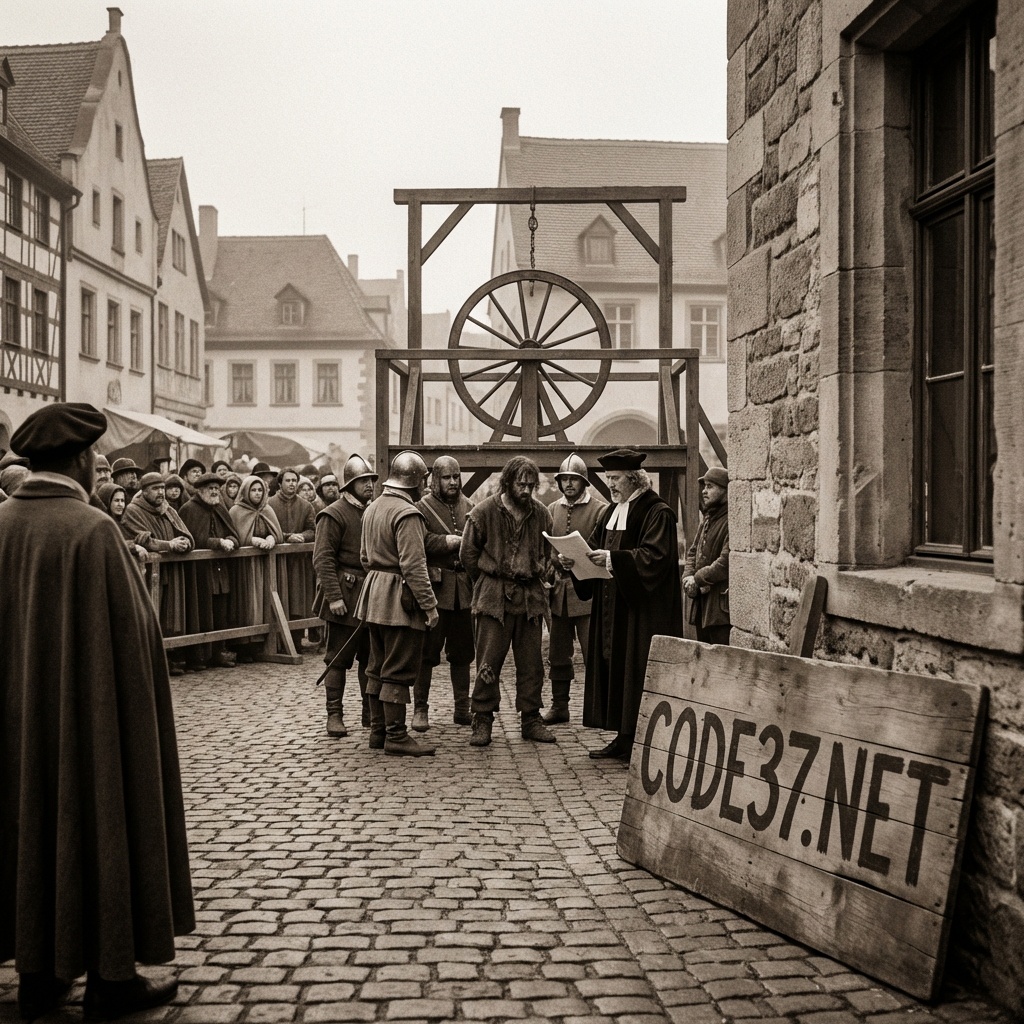
In the 16th and 17th centuries, people were accused not only of witchcraft and sorcery, but also of being werewolves. One person who was actually convicted of being a werewolf was Martin Blome in 1605. He was born in 1562 as the son of a tenant farmer in a humble hut in Greven. Martin Blome attended the cathedral school in Münster and subsequently worked as a merchant’s assistant for his uncle Johann von Coesfeld in Neuss. He then worked in the courier service at the electoral chancellery in Münster before setting up his own business as a general merchant on Rothenburg Street. His business flourished, and soon his trade expanded abroad. Naturally, people wondered how the young man from a poor family had managed to build up such a business. Various rumors quickly began to circulate. Martin Blome, who was married for the second time, was said to be a werewolf who had robbed a merchant on his white horse between Uelsen and Hardenberg. He was also alleged to have murdered a woman named Marie Offenbrügge in order to steal her textiles. Meanwhile, in the fall, the soldier Schramhenrich, who lived in the St. Mauritz district of Münster, reported his wife Christina missing. Their marriage had been in crisis for some time, which is why Christina had left him, and since then she had vanished without a trace. In the spring of 1605, it was reported to the soldier Schramhenrich that his wife Christina had been seen by carters together with the dubious Martin Blome at Holtmann’s tavern on the Hardenberg near Itterbeck. He then asked his friend Johann Schulte to inquire around the area. Schulte sought out the judge of Uelsen, who informed him that in early January 1605, off the path from Uelsen to Itterbeck, a strangled woman had been found whose nose, both ears, and a finger had been cut off, as if a wolf had torn her apart. Next to the body lay her straw hat and a basket. Schulte took these two items to Schramhenrich, who clearly identified them as belonging to his wife. But who had murdered Christina? Was Martin Blome behind it? To answer this question, Schramhenrich and Schulte hatched a plan. They took the items found at the crime scene to Martin Blome’s regular tavern, located next to the Minorite Church on Neubrückenstraße. There they placed them so that when he entered the tavern, he would see them immediately. When Martin Blome entered and saw the items, he turned pale as a sheet and immediately wanted to know where they had been found. There was no doubt that Blome had recognized the items. The next day, in an effort to solve the murder of Christina Schramhenrich, the police questioned the carters, who stated that Martin Blome had spent the night with Christina Schramhenrich at Holtmann’s Inn near Hardenberg. When they were about to leave the next day, some people taunted Christina as an adulteress, whereupon she fled into the heath. Since adultery was a criminal offense and the mayor confirmed that Blome had lodged at Holtmann’s Inn with Christina Schramhenrich, he was arrested on March 28, 1605, at the behest of the Münster City Council on charges of adultery, and at the same time, the investigation into the murder of Christina Schramhenrich was intensified. Martin Blome was interrogated; while he admitted to having had a rendezvous with Christina Schramhenrich at Holtmann’s Inn, he vehemently denied her murder. Instead, he accused a wasenmeister of having left with Christina Schramhenrich the following morning. He stated that the body had been covered with a Lazarus coat. The wasenmeister had also been wearing one. The judges also questioned Martin Blome about his wealth. He explained his sudden wealth by saying that his uncle had given him money that he had inherited. Moreover, he had always worked hard for his money. After the interrogation, Baron Johann Kerkerinek was sent to Uelsen, Itterbeck, Neuenland, and Nordhorn. When he returned, he had gathered evidence that strengthened the suspicion against Martin Blome. On April 23, Martin Blome was interrogated again. This time, however, torture was employed—a procedure known as “peinliches Verhör” (painful interrogation)—which took place in Münster at the Niesingturm and Ludgeritor. During this process, all the evidence was presented to the accused once more, and he was urged to tell the truth. If the accused still did not confess, the executioner began the torture. First, the accused was shown the instruments of torture. The prisoner was then forced to undress, and the instruments were applied to him. If the accused still refused to speak, the executioner began the torture. This torture consisted of applying thumb and leg screws, which were intensified with lashes and hoisting. During the hoisting, the accused’s hands were bound behind his back and his body was pulled upward by a rope attached to his hands; to increase the pain, weights were hung from his feet. Furthermore, the torture was intensified by sleep and food deprivation, the tearing off of fingernails and toenails, and the use of the rack, which was fitted with sharp blades. Under torture, Martin Blome confessed to having strangled Christina Schramhenrich as a wolf in human form and, in the process, disfigured her face like a wolf. On July 9, 1605, Martin Blome was found guilty by the judges of the murder of Christina Schramhenrich and of adultery and sentenced to death. Martin Blome received the most severe death penalty under the Criminal Code of the Holy Roman Empire of the German Nation, which Emperor Charles V had enacted in 1532 at the Imperial Diet of Regensburg—the so-called Constitutio Criminalis Carolina. This code prescribed breaking on the wheel for murderers. Martin Blome was placed on the wheel on the very same day of the verdict. The executioner severed his arms and legs with an axe, and only after some time was he beheaded. His lifeless body remained on the wheel as a warning, and his head was impaled on the wheel’s post. Thus ended the life of Martin Blome, the alleged werewolf.