Isabella Mueller (crime writer)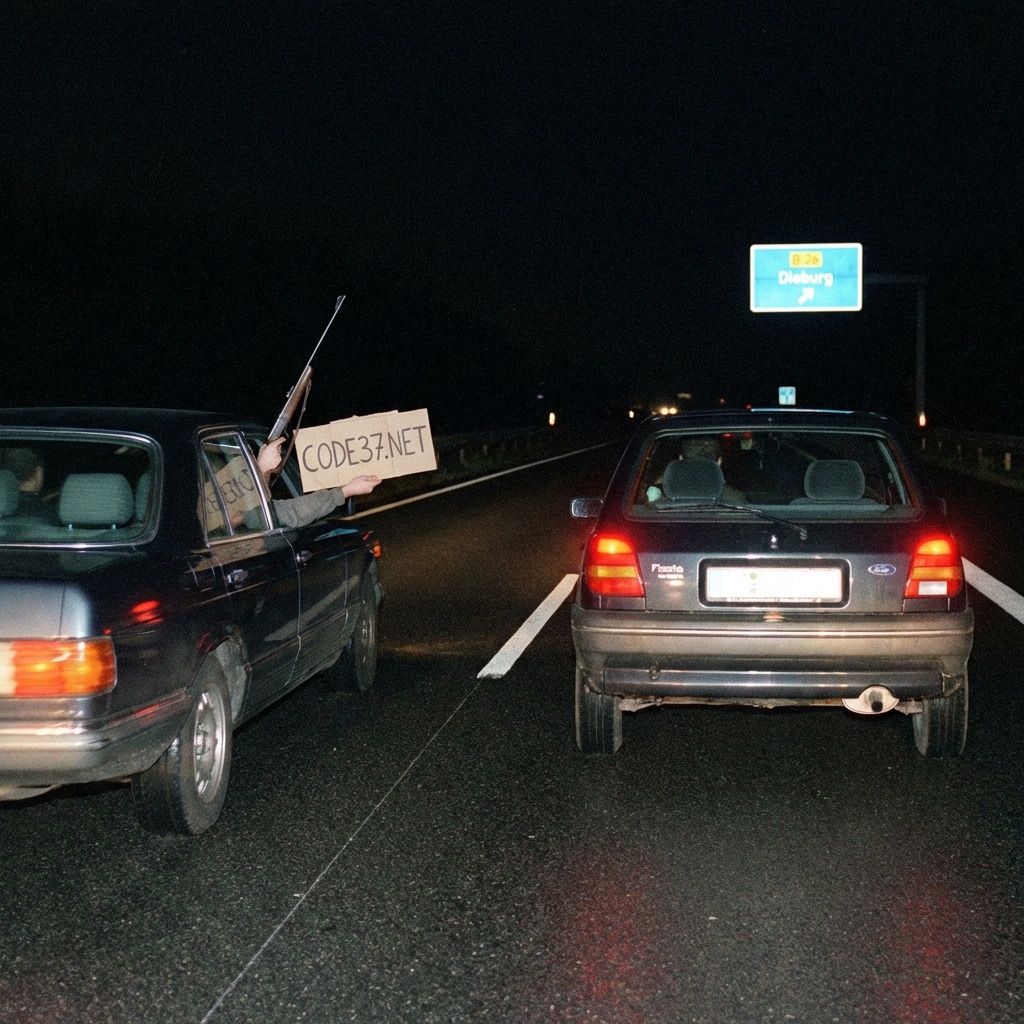
A politician’s son gone astray and then implicated in a murder case—that was, of course, a political disaster for a high-ranking local politician. That’s why everything was arranged so that, in the end, the young scion got off with a suspended sentence and community service, while his two accomplices ended up behind bars. But let’s take it one step at a time. On the night of July 29, 1995, between 1:30 and 1:45 a.m., 41-year-old heating technician Peter Wilhelm Kaffenberger from Münster was driving his Ford Fiesta on the B 26 near Dieburg when a car overtook him and the passenger fired a pump-action shotgun at him for no reason. The shotgun pellet pierced the headrest and entered the back of Peter Wilhelm Kaffenberger’s head, causing him to crash into the guardrail at the junction of the B 26 and the B 45. He died shortly afterward from his injuries at the University Hospital in Giessen. Who, and above all, why did Peter Wilhelm Kaffenberger have to die? There were no witnesses, but a shell casing was found at the crime scene. The police were completely in the dark as to who had shot Peter Wilhelm Kaffenberger. But then chance came to the police’s aid. In September 1996, a police patrol stopped two young men and their vehicles at a forest parking lot near Weiterstadt. One of the vehicles had a stolen license plate. Inside the vehicle, a police officer found a vast array of burglary tools as well as a Maverick pump-action shotgun. This turned out to be the murder weapon used to kill Peter Wilhelm Kaffenberger. The young men were not ordinary petty criminals, but rather high school graduates from middle-class families. One of the two young men was from Babenhausen and wanted to study law. His friend turned out to be the son of a high-ranking local politician from Dieburg. During the investigation, it emerged that the duo was actually a trio. The third man was a 19-year-old industrial clerk from Sickenhofen. For 16 months, the three computer geeks had terrorized the region with car thefts and burglaries and had even murdered a person in cold blood, a charge that the politician’s son, in particular, vehemently denied. He was considered the ringleader of the gang; it was on his initiative that the trio had traveled to Strasbourg to purchase a shotgun and ammunition for each of them, which they smuggled across the border. Just a few weeks later, they shot at traffic signs and a speed camera after being caught speeding following an attempted robbery at a gas station near Hanau. Making bombs was also on their agenda. It was all about the sheer desire to destroy. The trio coordinated their burglary sprees via email. These messages were secured by the police. However, the prosecution had the hard drive formatted before the trial, so that everything was completely erased. Furthermore, evidence mysteriously disappeared. This included the gunshot residue on the victim’s skull, which was not further examined but destroyed due to lack of space. Consequently, it could not be proven that Kaffenberger was shot at close range, but rather from a distance of 5–6 meters. The whole thing reeked of corruption. Before the murder weapon was discovered, a 23-year-old man from Aschaffenburg had been arrested for the murder of Peter Wilhelm Kaffenberger and spent six months in pretrial detention. He accused the special task force of the criminal investigation department of forcing him to make a false confession. The same thing happened to the 19-year-old industrial clerk from Sickenhofen, who was forced by the same police officers to confess to shooting Kaffenberger. He was to be made a scapegoat so that the politician’s son—who had likely been driving in a vehicle behind Kaffenberger and had signaled to his friends via flashing headlights or cell phone that the coast was clear—could get off scot-free. The driver of the murder car, the aspiring law student and best friend of the politician’s son, claimed that his friend, the business administrator, had shot at Kaffenberger completely out of the blue as he passed him. Ultimately, the business administrator—who, as a passenger, had fired the shot at Peter Wilhelm Kaffenberger for fun, as in video games—and the driver of the car, the aspiring law student from Babenhausen, were convicted in May 1988 by the Darmstadt Regional Court for the murder of Peter Wilhelm Kaffenberger. The business administrator, who had recanted his confession, received a 7-year prison sentence. The politician’s son was let off the hook. In a three-hour trial before the Dieburg Juvenile Court, having served a total of only four weeks in pretrial detention, he was sentenced to probation and 400 hours of community service, allowing him to take his seat in the lecture hall just in time for the first semester. Money really does rule the world.