Isabella Mueller (crime writer)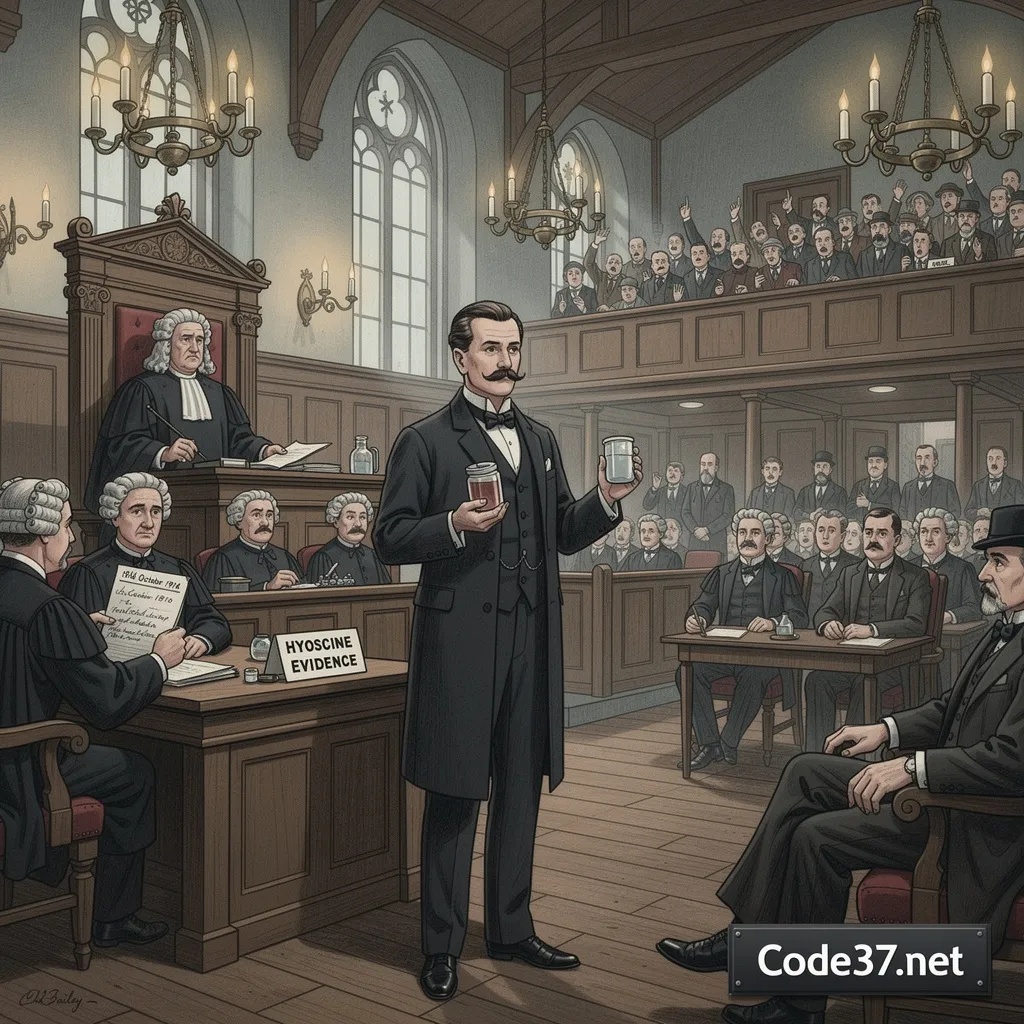
The so-called “Crippen Case” is still considered one of the most spectacular criminal cases in Great Britain. The protagonist of this murder case was Hawley Harvey Crippen, better known as Dr. Crippen, who was the first suspect to be arrested with the help of wireless telegraphy. This was a groundbreaking event in criminal history. Crippen was born on September 11, 1862, in Coldwater, where he grew up as an only child in modest circumstances. He completed his education at Cleveland Homeopathic Medical College in 1884. After the death of his first wife in 1892, he placed his son in the care of his parents and moved to New York, where he practiced as a homeopath for the popular homeopath Munyon. In 1894, he married his second wife, Corrine “Cora” Turner, a talented musical theater artist known as Belle Elmore. The couple moved to London, where Crippen managed Munyon’s branch office but was never able to practice medicine due to his lack of medical qualifications. The relationship between Crippen and Cora was turbulent, as Cora not only had extramarital affairs but also consumed a great deal of alcohol. Her breakthrough as an opera singer failed to materialize, which put even more strain on their relationship. Eventually, the couple moved into a house at 39 Hilldrop Crescent in the Holloway district of London. They sublet it to supplement Crippen’s meager salary. Crippen himself began an affair with his secretary, Ethel Le Neve, which would lead to a dramatic turning point. On the evening of January 31, 1910, Cora disappeared after a party the couple had hosted at their home. Crippen claimed that Cora had returned to the United States and died. However, Cora’s friends did not believe Crippen, whose mistress Ethel not only wore Cora’s clothes and jewelry, but had also moved into their shared home, so they notified Scotland Yard. Chief Inspector Walter Dew then invited Crippen in for a routine interrogation. Crippen, a slight man with a distinctive mustache, admitted that the story of his wife’s death was a lie. His wife had eloped to the US with another man, and he had lied out of shame. The Chief Inspector actually believed him, but Crippen fled, which proved to be his undoing. The police then began searching Crippen’s house, which led to a shocking discovery. During the search, investigators discovered a human torso under the floor of the basement, and analysis revealed that the body part contained traces of hyoscine, also known as scopolamine – a poison that Crippen had purchased before the night of Cora’s disappearance. The case quickly developed into one of the most spectacular murder trials of the early 20th century. Crippen had fled to Brussels with his mistress, Ethel Le Neve, before traveling to Antwerp the next day, where he boarded the Canadian Pacific liner SS Montrose bound for Canada. Crippen posed as Mr. John Robinson, who had shaved off his mustache and was traveling without his glasses. His mistress had disguised herself as a boy. Ethel pretended to be Mr. Robinson’s son. But the story took an exciting turn when the ship’s captain, Henry George Kendall, informed the British authorities. This was because the ship was equipped with a new type of radio telegraph. Chief Inspector Dew immediately boarded the SS Laurentic. This was a very fast liner that caught up with Crippen despite his three-day head start. The inspector arrived in Quebec before Crippen, contacted the Canadian authorities, and on July 31, disguised as a pilot, boarded the SS Montrose, where he arrested Crippen and his lover in Canadian waters. Crippen was even relieved when he realized the game was over. Crippen’s trial began on October 18, 1910, at the Old Bailey and caused a great stir. The jury found Crippen guilty – in just 27 minutes. One reason for this was that the physician and toxicologist William Henry Willox was able to detect the poison hyoscine in the dead woman’s tissue, which Crippen had purchased at the pharmacy before the murder. Crippen had administered an overdose of the narcotic. He then dismembered her body, burning her limbs in the kitchen stove while dissolving her internal organs in acid in the bathtub. He buried the other body parts, including the blood-stained pajama top, in the basement of the house. Crippen was sentenced to death by hanging for the murder of his wife. His mistress, Ethel Le Neve, could not be proven to have been an accomplice and was therefore acquitted. On November 23, 1910, Hawley Harvey Crippen was hanged at 9 a.m. by John Ellis at Pentonville Prison in London, while his mistress fled to the United States and later lived in Canada before returning to Great Britain in 1915, where she died in 1967. Crippen’s last message was a desperate plea of innocence. He claimed until the end that his wife had returned to the United States. This claim does indeed raise questions in light of new forensic evidence that came to light in 2007. Recent DNA analysis has cast doubt on the identity of the remains found in the basement of the Crippen house. The results show that they may not have been Cora’s remains. This has sparked a new debate about the validity of the trial at the time and leaves room for speculation about possible misjudgments and cover-ups on the part of the authorities. The Dr. Crippen case is much more than just a historical crime. It is a fascinating puzzle of intrigue, love, betrayal, and the pursuit of justice. The shadow this case casts on the justice system remains to this day and continues to capture people’s imaginations as the image of the “Murderer of London” continues to unfold. What really happened on that fateful evening in January 1910? Was Hawley Harvey Crippen truly a cold-blooded murderer, or was he the victim of a flawed justice system? The answer remains open, lending the story of Dr. Crippen a mysterious appeal that will never completely disappear.