Isabella Mueller (crime writer)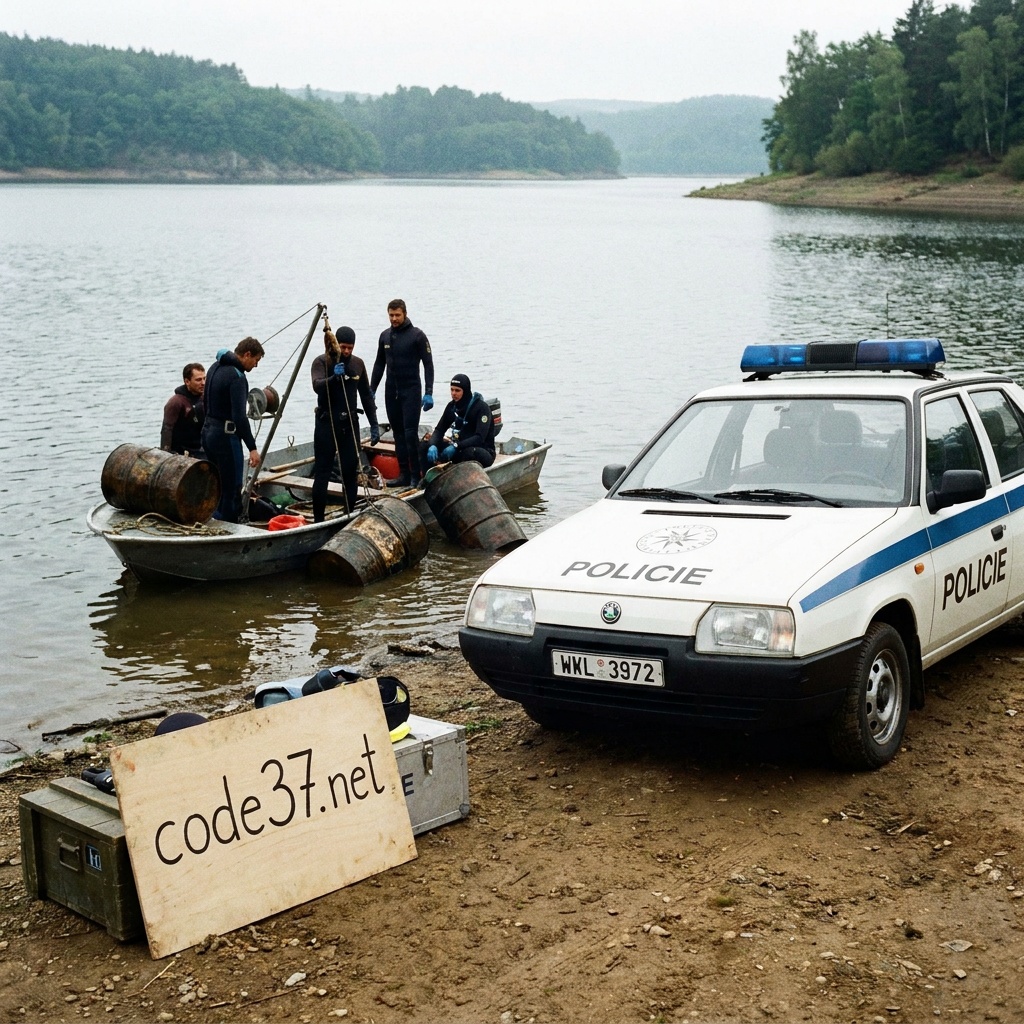
The Czech police made a truly gruesome discovery in the large Orlík reservoir, situated south of Prague. There, inside a rusty barrel, they found a dismembered body that had been doused with caustic soda to cause it to decompose. Shortly afterwards, in the summer of 1995, police divers found further bodies in barrels. The victims were all shady businessmen who, as the police later discovered, had been carrying large sums of cash with them in the hope of securing lucrative deals – which is why they were killed. The bodies were then placed in barrels, doused with caustic soda and sunk in the reservoir. The series of murders took place between 1981 and 1993 and was carried out by a criminal gang that later became known in the media as the Orlík killers. The gang’s leader was Karel Karlos Kopác, who carried out the series of murders together with his childhood friend Vladimír Kuna, his sister Irena Meierová, her boyfriend Petr Chodounský and his friend Ludvík Černý. The gang’s first victim was the businessman Aleš Katovský, whom Kopác had met in 1991 and who had subsequently hired him as a bodyguard. On 5 April, the gang put their plan to rob and then kill the businessman into action. On that day, Kopác drove him to a client in Rudná who was interested in a currency exchange. In reality, however, the client was gang member Černý, who shot him in the head whilst they were in the car. They then wrapped the body in wire mesh at a rubbish tip and disposed of it in the reservoir. Their haul amounted to 800,000 crowns. On 9 January 1992, Leorent Lipoveci became the gang’s second victim; he had gone to Kopác’s flat – where Černý and Kuna were also present – to buy a gun. Whilst he was in the process of choosing a gun, Černý suddenly shot him in the head for absolutely no reason. From then on, this victim was referred to as ‘the Patient’, in reference to a psychiatric institution. Their haul amounted to 30,000 crowns. After the murder, Kuna came up with the idea of putting the bodies in barrels, pouring acid over them and disposing of them in the reservoir. The third victim was the antique dealer Vlastimir Hodr, from whom Černý wanted to steal a golden seal. He killed him single-handedly. He then called on Kopác and Kuna to help dispose of the body. The fourth victim was Kuna’s mother, Anna Medková. To get rid of her, they sent her a parcel to her home in Mnichovice on 7 February 1992. It contained TNT, Semtex and screws. When she opened it, the parcel exploded. Kuna’s mother suffered serious injuries but did not die, so Kuna planned to suffocate her with a pillow in hospital. However, she died in hospital five days later. In total, the death of Kuna’s mother netted them 1.6 million crowns. Černý then attempted to murder the police officer Ján Mato in order to get hold of his service badge and his flat. However, this attempt failed because the gun jammed and failed to fire. The policeman was not murdered until 2002 in a Prague underground station. Černý carried out the next murder without any involvement from his gang members. On 1 June 1993, acting on behalf of Yugoslav drug dealers, he killed the Kosovo Albanian Afrim Kryziu. He received 100,000 crowns for this murder. The gang planned to open a sex club, but none of them were creditworthy, which is why Kopáč asked his brother-in-law, Jaroslav Meierová, to take out a bank loan against his house. However, Jaroslav refused. When Jaroslav’s wife, Irena, found out about this, she agreed on the condition that her brother and his friends would kill her husband. Irena wanted to live with Petr Choudounsky. Kopáč initially agreed, but did not have the contract killing carried out, which is why his sister and her boyfriend hired Černý, who killed Irena’s husband on 6 July 1993. The payment for this was 100,000 crowns. Just under half a year later, on 7 January 1994, a horrific car accident occurred. Kuna was travelling in the car with Kopáč when the latter lost control. Whilst Kuna was only slightly injured, Kopáč was left paraplegic and no longer wished to engage in any criminal activity. In January 1993, rumours first began to circulate that businessmen had suddenly disappeared. Černý fuelled these rumours further by boasting about the murders. There was no evidence to support this until traces of blood were found on the bonnet of Černý’s car, which had once belonged to the murdered Aleš Katovský, who had sold it to a car dealer. Furthermore, it emerged that Černý had borrowed a car around the time Aleš Katovský was believed to have disappeared. The mileage travelled led to the Orlík Reservoir, which police divers searched on 10 July 1995 and, after a few days, found the barrels and the body wrapped in wire. When Kopáč heard about this on television, he attempted to take his own life. Initially, Kopáč refused to cooperate; he had been shot in the groin during his arrest. However, after he learnt that the others had pinned all the blame on him, he spilled the beans without holding back. He made a written confession. This revealed that the lye had come from Ivan Roubal. Kopáč had used the money to buy a villa in the Vysočany district, where he intended to set up a gym. Following a four-month trial, all five defendants were found guilty on 18 April 1997. Ludvík Černý and Vladimír Kuna were sentenced to life imprisonment; Karel Kopáč was sentenced to 21 years’ imprisonment; Petr Chodounský to 14 years’ imprisonment; and Irena Meierová to 12 years’ imprisonment. All of them appealed against their sentences. However, the Court of Appeal merely reduced Meierová’s sentence to 10 years and Kuna’s to 25 years. Karel Kopáč could not accept this verdict. He hanged himself on 15 April 2004 using the drawstrings of his pyjamas in Kuřim Prison. His sister was released on parole in 2002 and now lives in Jinočany under a new identity. In 2011, Petr Chodounský was released from prison. On 18 June 2013, Vladimír Kuna was released from prison for good behaviour; he now lives near Chomutov with his new wife, whom he married in prison. Ludvík Černý changed his name to Zámečník; on 5 October 2017, he applied for parole, but this was refused as it emerged that he had committed offences as early as 1990 and also whilst in prison. The barrels in which the bodies were once kept can now be viewed at the Police Museum in Prague.