Isabella Mueller (crime writer)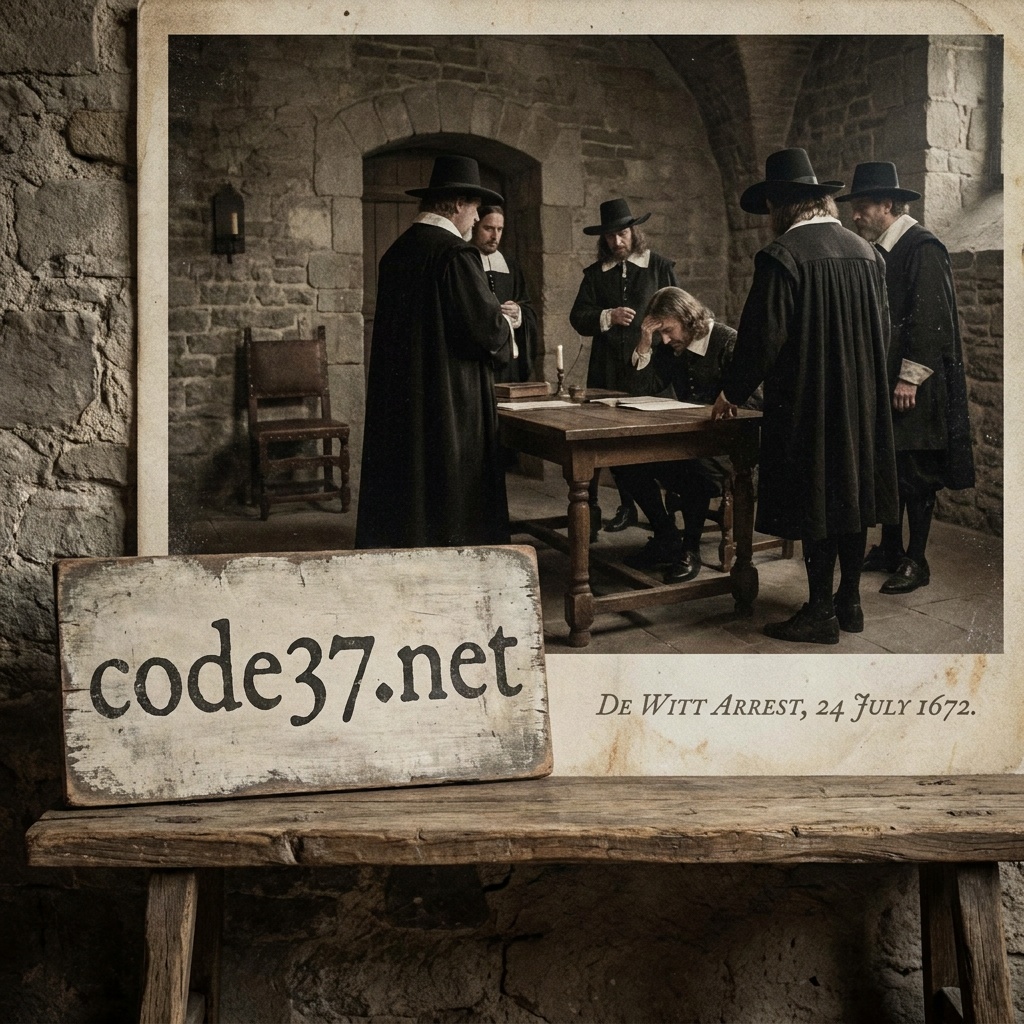
1672 is considered the year of catastrophe for the Netherlands, known as the “Rampjaar,” during which a brutal lynching of the brothers Johan and Cornelis de Witt took place, based on a diabolical plot. For two decades, from 1650 to 1672, the country experienced its first period without a stadtholder, during which the seven Dutch provinces were effectively sovereign. They formed a loose confederation known as the “Republic of the United Netherlands” and abolished the office of stadtholder in 1650—following the Peace of Westphalia, which cemented the Netherlands’ independence from Spain—due to the House of Orange’s obsession with power. The most important body of this unified state was the States General, whose highest representative was Johan de Witt. He was, so to speak, the statesman of the Republic. His brother Cornelis was a member of the Admiralty and proved himself a successful commander of the fleet in two naval wars against England. On May 8, 1654, the First Anglo-Dutch War ended with the Treaty of Westminster. This treaty included a secret supplementary protocol that excluded William III of Orange from the office of stadtholder. The Netherlands was in its Golden Age and was a major political and military power in Europe, guided in domestic, foreign, and trade policy by Grand Pensionary Johan de Witt. However, due to the two naval wars, Johan de Witt had strengthened the fleet but not the land forces, so that after England and France declared war, the French troops of the Sun King, Louis XIV, overran the country. They could only be stopped by breaching the dikes. This, however, ruined the harvests, which turned the people against the de Witt brothers. The 21-year-old William III of Orange took advantage of this situation; together with his supporters and Calvinist clergy, he launched a veritable smear campaign against them, which led to a change in power: Johan de Witt was overthrown, and William III of Orange was appointed stadtholder of Holland. Johan de Witt had been unable to prevent this appointment as stadtholder, as he had been the victim of an assassination attempt on June 21, 1672, and was therefore unable to leave his sickbed. Following William III of Orange’s appointment as stadtholder, Johan de Witt resigned as Grand Pensionary. From then on, he was accused of collaborating with the French, while his brother Cornelis was accused of having offered the shady Willem Tichelaar 30,000 guilders to assassinate William III of Orange. This incredible pretext, which was completely far-fetched, led to Cornelis de Witt’s arrest on July 24, 1672, by a narrow majority of the criminal court. Despite horrific torture, he made no confession and was sentenced by William III to lifelong exile. On August 20, Bossy, the daughter of a prison guard, handed this letter to Johan de Witt, who was to pick up his imprisoned brother Cornelis at the Gevangenpoort, the prison in The Hague. When Johan de Witt arrived there, he found an angry mob already gathered outside the prison gates. After the de Witt brothers had completed all the formalities and were about to leave the prison, the roaring mob was already waiting for them, so they returned to the prison. The atmosphere grew increasingly heated due to alcohol, until the mob stormed the prison and attacked Johan and Cornelis with knives, blows, and rifle butts. The mob intended to drag the de Witt brothers to the place of execution. A pistol shot killed Johan first; Cornelis died shortly afterward. What happened next was almost unparalleled in its cruelty. The enraged mob dragged the bodies of the de Witt brothers to the scaffold, where they were hung by their feet. Their tongues were cut out, their arms, fingers, noses, lips, and genitals were severed, and their bodies were disemboweled. Afterward, their hearts were displayed to the cheering crowd. It was not until nightfall that their bodies could be buried by their families in the Nieuwe Kerk. William III of Orange is said to have been the mastermind behind the lynching of the de Witt brothers, having provided both Willem Tichelaar and others with generous pensions.