Isabella Mueller (crime writer)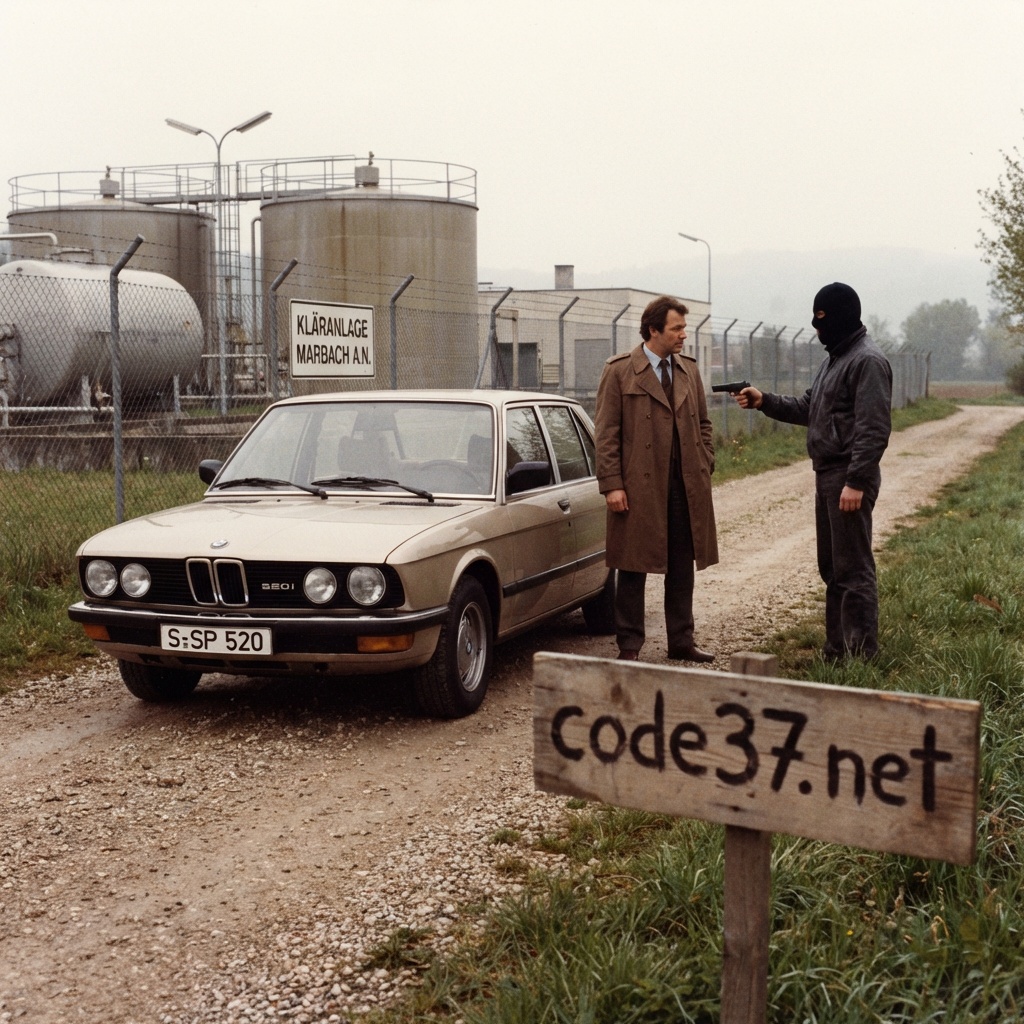
One of Germany’s most spectacular series of robbery-murders took place in the mid-1980s. At remote rest stops, a masked man would lie in wait for lone men, whom he shot in cold blood so he could use their cars to rob a bank. The perpetrator struck for the first time on May 3, 1984, at a hiking parking lot not far from the “Häldenmühle” sewage treatment plant in Marbach am Neckar. There, 47-year-old engineer and traveling salesman Siegfried Pfitzer had stopped for a short break. He did not know that this would be the last one of his life. Suddenly, a masked man held a pistol between his eyebrows and pulled the trigger. The perpetrator then drove the victim’s car, a BMW 520i, to the Burgstetten-Erbstetten bank branch, where he smashed the window of the teller’s window with a sledgehammer—an act that earned him the nickname “Hammer Murderer” in the media. He made off with 4,790 marks during the robbery. At first, the police were completely in the dark in their search for the perpetrator. Only the pistol, a Walter P5, perhaps provided the first clue that the perpetrator might actually come from within their own ranks, since the police forces of Baden-Württemberg and Rhineland-Palatinate had been using this model as a service weapon since 1979. On December 28, 1984, the Hammer Murderer struck a second time at the Rohrbach forest parking lot. This time, he shot and killed 37-year-old Englishman Eugene Wethey, who had stopped there on his way to a skiing vacation in Switzerland. The perpetrator stole the victim’s light green Golf and robbed the Volksbank branch in Cleebronn, where he again wielded his sledgehammer and ultimately made off with 78,000 German marks. That very evening, the police established the “Hammer” task force, which was based at the Großbottwar school complex. Over 540 tips were received there over the next four months, and more than 1,000 people were interviewed. Even 37 tons of soil were excavated from the parking lot of the first crime scene in an effort to find the projectile. A segment on the popular television show “Aktenzeichen XY … ungelöst” was also broadcast on June 5, 1985. Yet all efforts proved fruitless. The murders and robberies continued. On July 22, 1985, 26-year-old Wilfried Schneider fell victim to the Hammer Murderer. The electrician had stopped for a break at the hiking parking lot on the L 1100 between Ilsfeld and Flein when he was suddenly struck by a fatal shot. The perpetrator fled in the victim’s black Golf GTI and drove to the Raiffeisenbank Spiegelberg. But when he entered the teller area, the branch manager greeted him with the words “Here comes the Hammer Killer,” whereupon the perpetrator left the bank branch again without having accomplished anything. The perpetrator switched to his own car and was stopped at a police checkpoint, but was allowed to continue after his papers were checked. Two months later, on September 27, 1985, the Hammer Murderer robbed the Raiffeisenbank in Rosenberg, where he stole 11,000 marks and fled in a bank employee’s car. This time, a composite sketch was created, which led to Norbert Pöhlke. The 34-year-old married father of two was himself a mid-level police officer in Baden-Württemberg who lived in a stylish home in the village of Strümpelbach but was heavily in debt. Norbert Pöhlke was questioned. However, due to investigative errors, the police did not pursue his lead further. In the meantime, a police officer of Italian descent also came under suspicion, but this turned out to be a mistake. After examining over 4,482 leads, the investigators once again focused on Nobert Pöhlke, a senior police officer and police dog handler with the Stuttgart II Regional Directorate. It didn’t take long for them to determine whether Nobert Pöhlke was the perpetrator, as the service weapons of all police officers in the Stuttgart area were checked against the bullets from the murder weapons. But before the handcuffs could be snapped on, Nobert Pöhlke shot and killed his wife Ingeborg and his 7-year-old son Adrian on October 13, 1985, at his home in Strümpelbach at Ludwigsburger Straße 26. He then fled to Italy with his 4-year-old son Gabriel. He drove over 1,400 kilometers until he arrived at the beach in Brindisi, where he first shot Gabriel and then himself. It was only after Nobert Pöhlke failed to report for duty on October 18, 1985, and the bodies were found in the house that it became clear that Nobert Pöhlke was the Hammer Killer. The series of robberies and murders began after the death of his daughter Cordula, who had died of a brain tumor in March 1984 at the age of 4. Nobert Pöhlke secretly blamed himself for his daughter’s death, as he had been unable to afford treatment from expensive private doctors for her. To this day, this series of robberies and murders remains one of the most sensational criminal cases in Germany, providing material for numerous films and books.