Isabella Mueller (crime writer)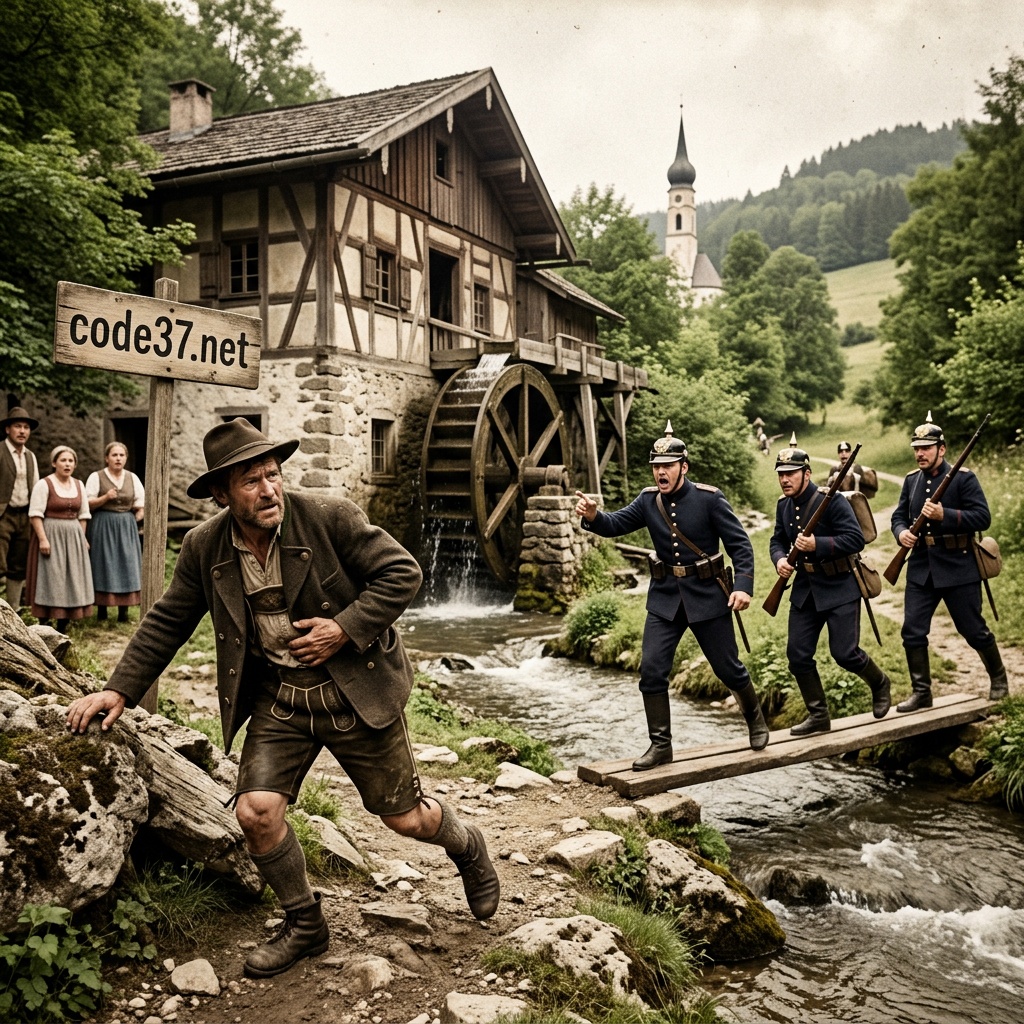
Mathias Kneißl was a true bandit legend who continues to inspire countless films and books to this day. This last bandit of Bavaria was born on May 12, 1875, in Unterweikertshofen. Mathias was the eldest of five siblings. His father, also named Mathias, was a trained miller who came from a respectable farming family. Mathias Kneißl’s mother, Therese, had Italian roots and was a passionate markswoman who taught Mathias and her youngest son, Alois, how to shoot at an early age. Her grandfather had once come to Unterweikertshofen from Italy and opened a general store there. But when Therese’s brother Johann Pascolini was killed during an attempted burglary in 1871, the Pascolini family fell into disrepute. After their wedding, Mathias’s parents took over the Pascolinis’ tavern, which soon became a hub for fences and poachers. In 1886, Mathias’s parents sold the inn where Mathias had entertained the guests with his harmonica playing. They bought the remote Schachenmühle near Sulzenmoos, which henceforth became a trading post for stolen goods and poached game. In Sulzemoos, the parish priest ruled with an iron fist, and the family, which was involved in shady dealings, was a thorn in his side. Since Mathias had skipped Sunday school in March 1891 to go dancing, he was placed under house arrest for three days. In the summer of 1892, the Herrgottsruh pilgrimage church in Friedberg was ransacked. All clues led to Mathias Kneißl. Four gendarmes went to the Schachenmühle to arrest him. But Mathias Kneißl managed to escape, though he was seriously injured in the process. When the gendarmes finally caught him, he died on the way to the Dachau prison. Shortly thereafter, Therese Kneißl was also arrested, leaving the children entirely on their own. This was particularly hard on Mathias’s youngest brother, Alois, who, along with his two older friends, Johann Schlumbrecht and Josef Schreck, committed burglaries and threatened people with his father’s pistol. When the police attempted to arrest him and his accomplices at the Schachenmühle, he fired at them. One shot struck Police Station Commander Balthasar Gößwein in the abdomen. Mathias, who was only 16 years old, was drawn into the shootout. Ultimately, Mathias, his brother Alois, and the two accomplices were arrested. A trial was held at the Munich II Regional Court, in which Alois was sentenced to 14 years in prison for attempted murder, and Mathias—despite his brother confirming that he had not fired the shot—was sentenced to 5 years and 9 months in prison for attempted manslaughter and other offenses. Therese Kneißl repeatedly submitted petitions for clemency seeking early release. But to no avail. Alois died of tuberculosis after four years in prison. Mathias successfully completed a carpentry apprenticeship at the Amberg prison, but still had to serve his entire sentence until the very last day. At the age of 23, Mathias was finally able to breathe the air of freedom again. He moved to Munich to live with his mother and two sisters, as the Schachenmühle had been foreclosed shortly before the trial. However, he soon had to leave the city, as the city revoked Mathias’s right of residence for two years due to his criminal record. Mathias Kneißl eventually ended up in Nussdorf, where he found a job as a carpenter in a carpentry shop. His greatest dream was to emigrate to America. He saved relentlessly for this. But after seven months, his time in Nussdorf came to an end when his master carpenter fired him due to his criminal past. After that, Mathias Kneißl could find no work anywhere. No one wanted to hire the former convict. Incited by his cousin Erhard Holzleitner, he committed a burglary at a hop farmer’s property. In the process, they stole mortgage bonds worth 2,500 marks, which they intended to sell in Oberschweinbach. There, they were exposed as thieves and fled. When Holzleitner was apprehended, he betrayed Kneißl, who had been wanted since November 11, 1900, and for whom a bounty of 400 marks had been offered. Holzleitner, meanwhile, was sentenced to 15 years in prison. Mathias Kneißl went into hiding in the Dachau region, which he knew like the back of his hand. Since he had outwitted the police, he was assured of the sympathy of the rural population, who always provided him with shelter. This was also the case on November 30. Mathias Kneißl had gone into hiding at the home of an old acquaintance of his father’s in Irchenbrunn. But Michael Rieger, the smallholder, had no good intentions. He sent a farmhand to the gendarmerie in Altomünster, who tipped them off about Kneißl’s whereabouts in order to collect the bounty. When the gendarmes arrived to arrest Kneißl, he shot the station commander in the leg, and the officer bled to death on the spot. The second gendarme was struck in the lower leg by a ricochet, which had to be amputated. But he, too, died. Now a massive manhunt began for Mathias Kneißl, whose bounty was increased to 1,000 marks. But the manhunt remained unsuccessful until Mathias Kneißl was betrayed by his own cousin, his former lover. On March 5, 150 gendarmes fired upon the Auermacher estate in Geisenhofen, where Mathias Kneißl was hiding. Firing 1,500 rounds, they stormed the estate and shot the unarmed Mathias Kneißl 21 times; he was rushed to the Munich Surgical Clinic for emergency surgery. It took five months for his health to stabilize enough for him to be transferred to the Augsburg prison, where he stood trial from November 14 to 19, 1901. There, Mathias Kneißl—who maintained that he had not intended to kill the gendarmes at the time—was sentenced to death by a jury heavily influenced by the prosecutor. This verdict was considered a miscarriage of justice. Prince Regent Luitpold rejected the petitions for clemency that were submitted to him. On February 21, 1902, at around 7 a.m., Mathias Kneißl was executed by guillotine in the backyard of the Augsburg prison by the executioner Franz Xaver Reichart. Prior to his execution, he had ordered six glasses of beer as his last meal. After the beheading, Mathias’s mother purchased the body for 60 marks in order to bury her son. Many people attended the funeral at the Augsburg cemetery, as Mathias Kneißl was revered as a folk hero by the common people for his rebellion against the authorities. To this day, many legends surround Mathias Kneißl, the last robber of the Bavarian lands.