Isabella Mueller (crime writer)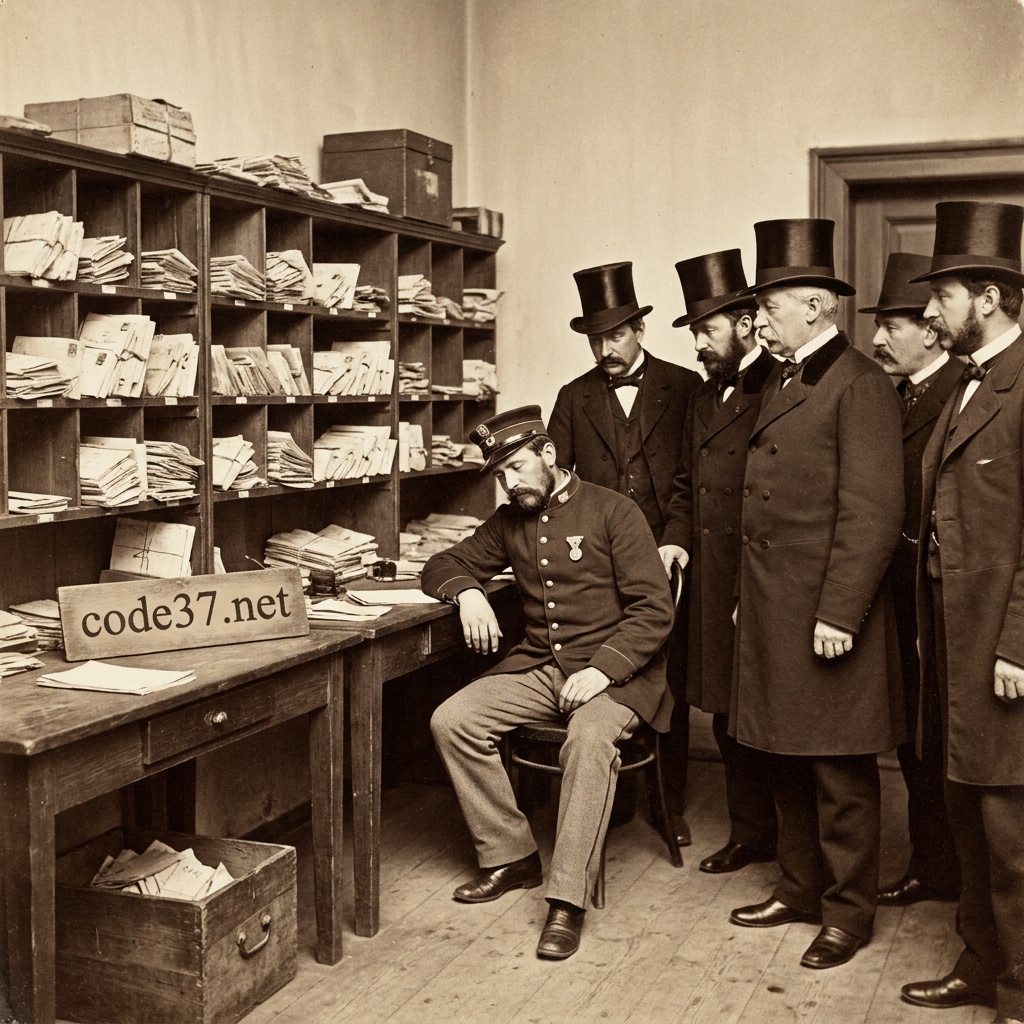
In 1862, the biggest letter theft of all time was uncovered in Vienna, in which a postal official had embezzled over 200,000 letters over a period of years, suspecting they contained money. The postal clerk in question was 32-year-old Karl Kalab, a helpful and hard-working man whom no one would ever have suspected of such a crime. Karl Kalab was born in Olomouc in 1830, the eldest of seven siblings. After attending grammar school, he quickly found a job with the post office. However, due to his father’s debts to a lottery agency, the whole family moved to Vienna, where his father leased another lottery agency and ran up debts once more. But Karl’s father had to give this up in 1859 due to an eye condition. From 1853, Karl worked as a postal clerk in a suburb of Vienna. He earned very little and therefore lived in his parents’ flat to save money. In September 1855, he became a trainee at the Imperial and Royal Main Post Office. Karl received a higher salary and even a housing allowance, which enabled him to afford a room in a new building. Karl was responsible for the large- and small-scale use of postage stamps, counter duties, sorting letters and processing registered mail. He was regarded as a dedicated employee who, in the autumn of 1858, was given the key to a drawer in which parcels were kept for collection. Over time, this drawer fell into disuse. It was soon discovered, however, that more and more letters were disappearing. Karl, who was regarded as particularly reliable, was entrusted with the investigation and managed to track down many of the missing letters fairly quickly. When one of the inspectors fell ill in the autumn of 1862, he was replaced by Karl. Yet as early as the spring of 1862, a postman noticed that Karl was holding back a particularly large number of letters. Letters were often held back if the postal official could not identify the destination. But as Karl had been working at the post office for so long, this seemed suspicious to them, as Karl should actually have known all the destinations. Moreover, Karl did not withhold any letters when he was being watched by an inspector. When the postman noticed that Karl had thrown an envelope containing letters into the disused parcel compartment, he informed an inspector of his suspicions. Karl’s superiors and police officers subsequently set up a commission. After a brief investigation, Karl was confronted with the allegations at the main post office on 8 April 1862 and asked to unlock the drawer. An envelope containing 24 letters was found inside. A further 44 envelopes containing letters were found in his desk. Karl confessed to having stolen and opened letters over the past three months, netting himself around 300 guilders. But the commission was not satisfied with this; Karl’s room in Vienna-Neuburg was also searched. There, an incredible 1,659 parcels containing over 56,284 unopened letters were found. It transpired that Karl had been embezzling letters since September 1857. After receiving the key to the drawer in 1858, he initially stole 60 to 70 letters a day, later sometimes as many as 300, which he took home with him in a handbag or travel bag. Karl had embezzled over 200,000 letters, many of which contained up to 100 guilders. In winter, he heated his flat exclusively with the letters. Karl did not squander the money he had swindled. He continued to live modestly, supported his parents, put money into savings accounts and bought himself two houses in Vienna-Hietzing. Naturally, the greatest letter theft of all time attracted huge media interest, and Karl Kalab’s name went down in criminal history, as the embezzlement of postal items has since been referred to as ‘kalabising’. The printed stamp ‘Embezzled and brought to fruition’ on the delayed letters became a catchphrase throughout Austria, as something had finally been achieved in Austria too. This newfound fame was of no use to Karl Kalab, who was sentenced in September 1862 by the Vienna Regional Court to 10 years’ hard labour for abuse of office and theft. This sentence was upheld by the Imperial and Royal Higher Regional Court on 11 November 1862. Kalab’s appeal was dismissed by the Supreme Court, which upheld the sentence by decree of 23 December 1862.