Isabella Mueller (crime writer)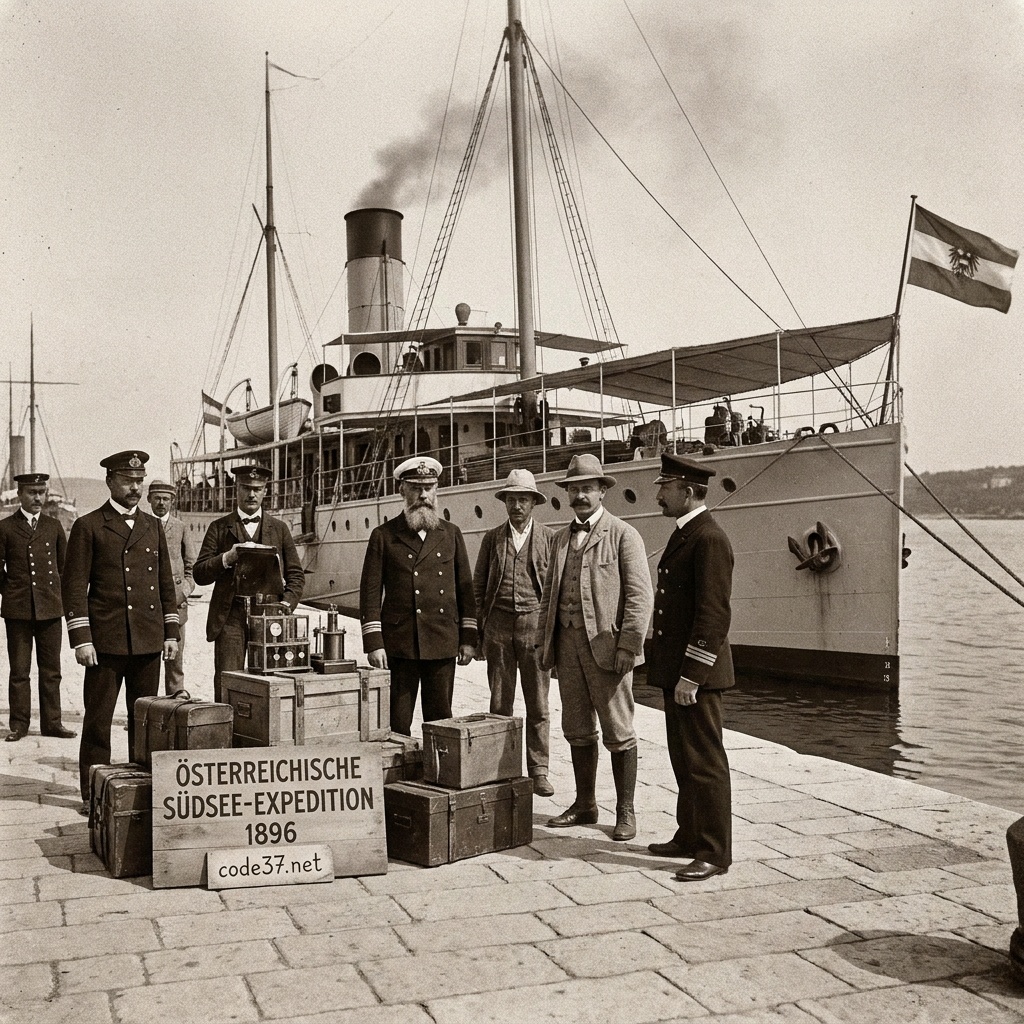
A horrific massacre in which over 40 people lost their lives took place on 10 August 1896 on Guadalcanal, the main island of the Solomon Islands, an archipelago in the South Pacific. On 2 October, the Viennese geologist Heinrich Freiherr von Foullon von Norbeeck, together with 113 people, set sail from the Austrian city of Pola aboard the gunboat ‘Albatros’ – provided by the Imperial and Royal Navy and commanded by Lieutenant Commander Josef Ritter Mauler von Elisenau. The expedition, under the scientific leadership of Heinrich Freiherr von Foullon von Norbeeck, was officially undertaken for purely scientific purposes, namely to carry out botanical and natural history studies. Unofficially, however, the aim was to search for nickel ores. This was because Arthur Krupp, the Austrian industrialist who financed the expedition, needed nickel for the production of armour steel. Although nickel was available in Austria, all the mines had been closed in the 19th century due to their unprofitability. As France had discovered nickel in its colony of New Caledonia in the South Pacific, Krupp suspected there might be nickel there too. He therefore persuaded the Naval Section to organise an expedition there. After months at sea, the ship arrived on the main island of Guadalcanal on 24 May 1896. On 5 August, an 18-strong expedition team set out from Gora Anchorgae on Guadalcanal to explore the island. Their destination was the ‘Tatube’ and ‘Lion’s Head’ mountains, situated on the southern shore. However, the ship was only able to dock on the northern shore, which meant the mountains could only be reached on foot. On 10 August, after several days’ march, the expedition reached ‘Tatube’. Whilst one group set up camp, a small party set out to climb the mountain. They were accompanied by Melanesian islanders. But suddenly, 300 natives armed with axes and clubs attacked the expedition team. A bloody massacre ensued in which six members of the expedition were killed. In addition to the sailors Gustav Chalaupka and Jakob Dokovic, the naval cadet Armand de Beaufort also lost his life. The head of the scientific team, Heinrich Freiherr von Foullon von Norbeeck, was seriously injured; like the sailor Peter Maras, he died of his injuries shortly afterwards. One could only speculate as to why the natives had suddenly attacked. It is said that the mountain was considered sacred, and no one was allowed to set foot on it. When the researchers did so, it sealed their fate. The survivors fled from the islanders to the Albatros, which set sail on 15 August 1896. The dead could not be buried, as the islanders had eaten them. It was not until five years later, in 1901, that officers of the Imperial and Royal Navy aboard the small cruiser SMS Leopard once again ventured onto the cannibalistic island of Guadalcanal to erect a memorial to the fallen on the beach at Gora Anchorage. For this purpose, a 2-metre-high cross was erected bearing the names of the dead and the golden inscription: ‘In memory of the members of the SMS Albatros expedition who fell heroically in the service of science during the battle at the foot of Mount Tatube’. During the Second World War, from August 1942 to February 1943, over 80,000 American and Japanese troops fought each other on the island of Guadalcanal. The island had become a target for the Americans because Japan was building an airfield there. The Americans subsequently launched Operation ‘Watchtower’, which ended with Japan’s surrender. Many thousands of people once again lost their lives on the island, which is why it is nicknamed ‘Death Island’.