Isabella Mueller (crime writer)
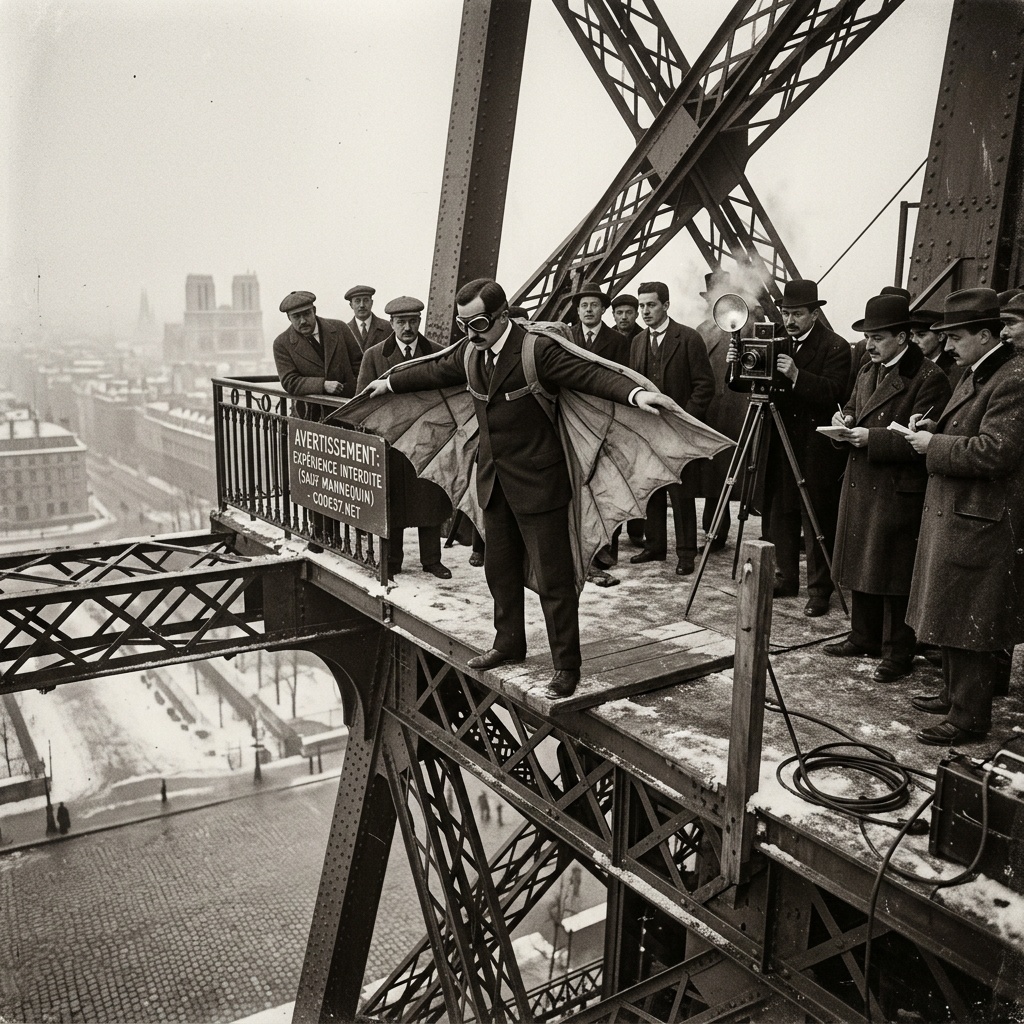
On 4 February 1912, exactly 114 years ago to the day, the life of a man who had sought to save the lives of crashing pilots with his invention of a portable parachute came to a tragic end. This man was Franz Karl Reichelt, who was not just an ordinary tailor, but also a visionary. Reichelt was born on 16 October 1878 in Wegstädtl and dedicated his life to the dream of flight. After completing a tailoring apprenticeship with his uncle in Vienna as a young man, he moved to Paris in 1898, where he opened a ladies’ tailor’s shop in the Opera district. At that time, no one could have imagined that the talented ladies’ tailor would one day cause such a stir that he would be immortalised in the history books. Although he mainly served fellow countrymen as customers and led an unassuming life, an insatiable inventive spirit was simmering beneath the surface. His first decade in the City of Love was marked by hard work and adapting to his new surroundings. But the burgeoning enthusiasm for flying in the 1910s was to seal Franz Reichelt’s fate. In 1909, Reichelt was granted French citizenship and changed his first name to François to better reflect his new homeland. As he had no family commitments and was unmarried, he was able to devote himself entirely to his innovative idea: the development of a parachute suit. Inspired by the increasing number of crashes involving daredevil pilots, Reichelt wanted to develop a suit that could bring people safely back to earth in the event of a crash. He drew on the work of aviation pioneer André-Jacques Garnerin, who had invented the first frameless parachute. What began as a modest experiment quickly developed into a scientific and technological obsession. In July 1910, Reichelt, a self-taught engineer, began designing parachute suits. However, the principles behind his designs often disregarded the laws of physics known at the time. Undaunted, he initially tested his designs on mannequins, which he threw out of the window of his fifth-floor flat in Paris. Although the results were not convincing, Reichelt remained undeterred and even applied for a patent for his invention. In October 1910, he finally dared to test the suit on himself. He jumped from a height of six metres onto a pile of straw and survived because the straw had cushioned his impact. This success gave him a false sense of security. Reichelt was convinced that his invention, although imperfect, had the potential to save lives. On the morning of 4 February 1912, his biggest test was to take place. With permission from the police authorities, who stipulated that he should use a dummy, Reichelt made his way to the first platform of the Eiffel Tower, 57 metres above the ground. The cool Parisian morning light was punctuated by the flashes of cameras as reporters and onlookers gathered to witness this groundbreaking experiment. Despite the freezing cold and the palpable scepticism of those present, Reichelt was determined to test his invention himself. At 8.22 am, having ignored the reporters’ warnings, Reichelt stepped to the edge of the platform. Wearing his ‘bat-like’ invention, which consisted of sturdy layers of fabric and padded wings, he leapt into the void. During his fall, which lasted almost four seconds, the suit failed to open as hoped, and Reichelt struck the frozen ground at full speed. The impact was fatal, and the event was meticulously captured on film by the Pathé film crew, bringing him posthumous fame. What many people do not realise, however, is that Reichelt never stopped believing in his vision. New information from recently discovered personal diaries and letters provides an insight into the inner world of this visionary tailor. In these writings, Reichelt expressed his deep concern for the safety of flying and took the accidents involving pilots particularly to heart. His passion was not merely professional ambition, but also a deeply felt sense of humanity. Furthermore, these sources document numerous previously unknown experiments and encounters with other contemporary inventors. Letters to the aviation pioneer Alberto Santos-Dumont and the engineer Gustave Eiffel show that Reichelt was part of a wider network of innovators, all of whom were obsessed with the idea of safe flight. These revelations lend a new dimension to his tragic end and underline the vision and courage that drove him. The story of Franz Reichelt serves as a reminder of how fine the line is between genius and madness, between success and disaster. Although his experiment failed miserably, the foundations he sought to lay were not entirely in vain. Even today, Reichelt’s courage and innovative spirit continue to inspire researchers and inventors to keep searching for ways to push the boundaries of what is possible and to make aviation safer. In Paris, Reichelt is remembered not only as the ‘flying tailor’, but also as a tragic figure whose dreams were greater than his time. His story serves as a powerful reminder that progress is often driven by those who are prepared to risk everything – even their lives. The unexplored aspects of his life and the documents that have now come to light offer us a more comprehensive insight into this fascinating man, whose legacy lies not in his failed jump, but in his tireless quest for a better future.