Isabella Mueller (crime writer)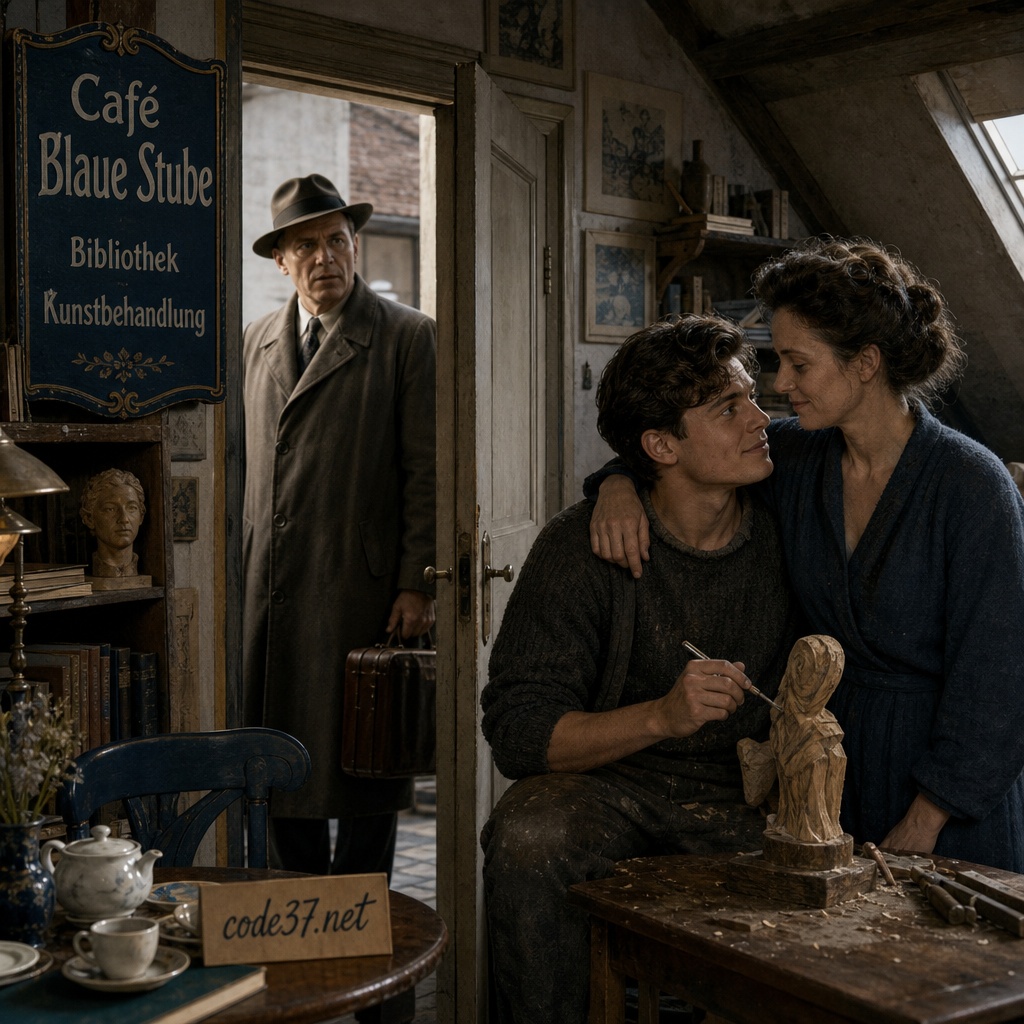
A sensational criminal case in postwar Germany was the murder of a man who had been brutally killed with an axe by his own wife. The murderer was the attractive, previously convicted Ruth Blaue, who was born on April 2, 1914, in Breslau as the eldest of three children. A few months after Ruth’s birth, the family moved to Halberstadt, where her father had taken a job as a meat salesman. After attending elementary school, Ruth went on to the Lyzeum, a secondary school for girls. In 1929, she earned her secondary school diploma, having successfully completed her studies in Hamburg-Lokstedt, where her family had lived since 1925. After attending a home economics school, Ruth went to a business school from April to September 1930. Ruth was an ambitious young woman who was by then employed at the Friedrichsberg Clinic, where she handled laboratory work and administrative tasks; as a result, Ruth began an apprenticeship as a laboratory technician at the University Medical Center Hamburg-Eppendorf. However, Ruth soon lost her job because she had embezzled letters from her supervisor. She kept this a secret from her partner, the resident physician Wolfgang Trautmann, whom Ruth married on August 23, 1933. But when he learned of the document forgery, he had the marriage annulled. Ruth avoided prison because a doctor certified her as not criminally responsible due to a “periodically recurring mental illness” that Ruth allegedly had at the time of the offense. Ruth, who was short on cash, continued to have a sexual relationship with Wolfgang, who supported her financially. But after she suffered a miscarriage in December 1933, she began working not only as a prostitute but also as an office clerk for a company. There, she fabricated orders in order to pocket the commission bonuses. Ruth was sentenced to prison by the Hamburg Magistrate’s Court for fraud, aggravated forgery, and embezzlement. Ruth served nine months in prison. After completing her sentence, she moved into a modest apartment that her parents had arranged for her. Starting in the spring of 1936, Ruth worked as a stenographer and office clerk at a real estate brokerage. Shortly thereafter, her fortunes finally seemed to have taken a turn for the better. She met and fell in love with the handsome merchant marine officer John Blaue, who was in the process of establishing a trucking company in Hamburg. Shortly before the start of World War II, Ruth and John were married in May 1940. John was stationed in Gotenhafen, which is why the couple moved to Danzig, where Ruth worked as a librarian for the Deutsche Werke. When John was transferred to Norway, he began an affair with a naval auxiliary. This relationship resulted in a daughter, who, however, died of diphtheria at the age of 3. Ruth herself was drafted into military service in 1943; she was trained in Hagenow and served as a searchlight operator near Bremen until the end of 1944. After Ruth was discharged from military service due to several nervous breakdowns, she began a new life. John had been taken prisoner by the British and was forced to work for the British occupying forces in Kiel. Ruth did not know when—or if—he would ever return. She settled in Elmshorn, where she lived in an attic apartment and earned a living running the café “Blaue Stube.” This café housed a library and an arts and crafts workshop. There she met the 21-year-old wood sculptor and former Luftwaffe pilot Horst Buchholz, whom she took in as a subtenant in her apartment. Horst became Ruth’s lifeline and the love of her life. But then, in April, her husband John suddenly appeared at the door. At first, he tolerated Ruth and Horst’s romantic relationship, but eventually moved into their shared apartment. Under the marriage laws of the time, a divorce was possible only with the husband’s consent—if at all. But John had no intention of granting it; despite Ruth’s affair, he insisted on her fulfilling her marital duties. Then, in November 1946, John suddenly disappeared. Allegedly, he wanted to go to the Soviet occupation zone to start a business there. At first, Ruth’s acquaintances believed these stories. As questions about John’s disappearance grew louder, she reported him missing to the Elmshorn Criminal Investigation Department on March 10, 1948. As early as the summer of 1947, children playing in the Liether Lehmkulen in Klein Nordende had made a gruesome discovery. They had found the severely decomposed body of a naked man inside a sack. Because his face was so badly mangled that it was unrecognizable, the man could not be identified immediately. The only clues were a gold tooth and a scar from an appendectomy. Although Ruth was later questioned in connection with her missing-person report, she did not know whether her husband had had a gold tooth. It wasn’t until November 1953, when Detective Otto Paukstadt from Itzhoe dusted off the file on the unidentified body from the gravel pit, that the case gained momentum. He discovered that the wire used to tie the sack shut was the same wire Horst used to tie up his artworks for his customers. The murder weapon also came from Horst’s workshop. After witnesses further confirmed that John had a gold tooth, Ruth and Horst—who were both living in the Black Forest by then—were summoned for questioning. There, they both became entangled in contradictions and ultimately confessed to the murder. However, they blamed each other for the crime. Both were arrested in August 1954 for the joint murder of John Blaue. But even before the trial began on November 9, 1955, Horst Buchholz committed suicide in his prison cell. Ruth then placed all the blame on Horst. She had merely mixed sleeping pills into John’s food. Horst then killed him with an axe and smashed his face. However, the court did not believe Ruth’s version of events—she was dubbed the “murderess with the face of the Madonna” in the media because Horst crafted Madonna figurines with facial features resembling Ruth’s. Ruth was sentenced to life imprisonment with deprivation of civil rights for the murder of her husband. The murder was so widely discussed that it was featured in the popular, high-rating crime series “Stahlnetz.” Ruth herself was released from Lauerhof Prison on January 31, 1969, by decree of the Minister President of Schleswig-Holstein due to her terminal breast cancer. Until her death on December 27, 1972, she lived in seclusion from the outside world in the Hanseatic city of Lübeck. To this day, this murder continues to provide ample material for books and films.