Isabella Mueller (crime writer)
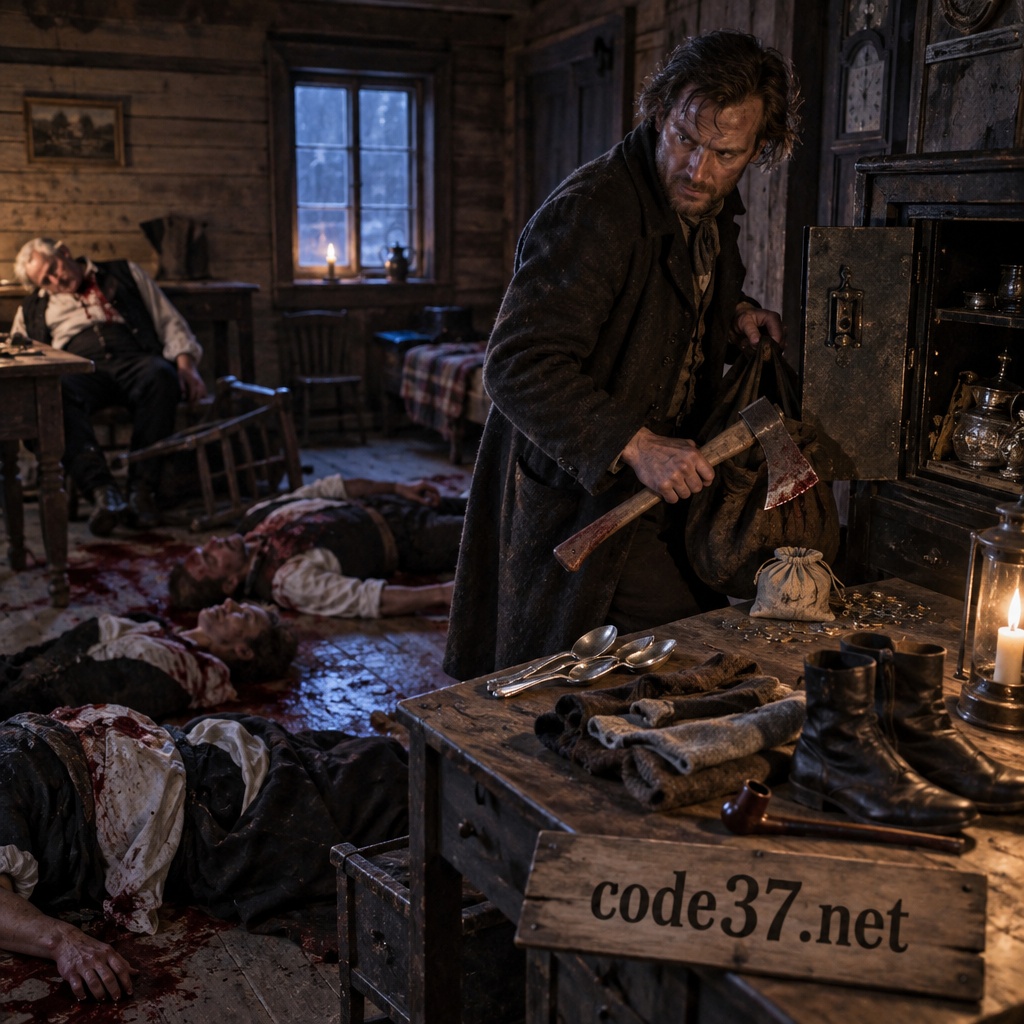
Peter Westerstrøm, better known as the Saksebøl Butcher, was a Swedish serial killer active during the Napoleonic Wars. This historical mass murderer was born around 1779 in the Swedish town of Ljungby. His father, Jonas, the local sexton, died when Peter was just eight years old. After his mother also passed away in 1804, he was raised under the care of his brother. He began his working life as a servant before starting an apprenticeship as a tailor, which he never completed, however. Westerstrøm later claimed to have set up a cotton-spinning business, which, however, failed due to financial difficulties. This account remains unconfirmed, however, as war was raging between Denmark, Norway and Sweden at the time and there were considerable doubts about his story. In 1806, Peter Westerstrøm moved to Norway, allegedly to avoid imprisonment for his immense debts. However, rumours circulated that he had fled to Sweden after murdering and robbing his former employer, Lieutenant-General Liljehorn. In Norway, he settled as a tailor in the town of Moss and sought work in the countryside. Two years passed before Westerstrøm carried out a veritable bloodbath in Saksebøl. On the night of 31 December 1808 to 1 January 1809, Westerstrøm completely lost control and committed an unimaginably cruel act at the small Saksebøl station in Hobøl. Westerstrøm murdered the station manager, Johannes Jensen, and his three servants, Lars Arvesen, Jens Svensen and Karen Olsdatter. He had brought the murder weapon – an axe – with him specifically for this crime. His motive was greed. He broke open the station manager’s safe and stole valuables. He fled with just 20 talers in cash, a few items of clothing, silver spoons, a pair of boots and a pipe. He attempted to reach the border with Sweden but was prevented from doing so by bad weather. The post-mortem examination of the four bodies was carried out by Dr Hans Munk. A commission of inquiry, comprising Judge Christian Magnus Falsen, Sheriff Jacob Wulfsberg of Christiania, Lieutenant-Colonel Hans Jacob von Scheel and Judge Ove Hiorth of Moss, was appointed. A reward of 1,000 talers was offered for information leading to the apprehension of the perpetrator. This sum led to Westerstrøm’s arrest by his own friends, who betrayed him to the police as a result. On 6 February 1809, Peter Westerstrøm was arrested in Moss and brought before the commission. After initially denying the charges, he confessed to the murders. His guilt was beyond doubt: he was still in possession of a large proportion of the stolen items and was able to lead the authorities to further hiding places. He cited various motives: firstly, he mentioned depression and a desire to commit suicide. Secondly, he claimed he wanted to become a notorious criminal who would go down in Norwegian history as the greatest villain. Finally, he said that revenge had been his motive, as he believed the stationmaster had prevented his engagement to a wealthy heiress. On 24 July 1809, Westerstrøm was sentenced by the commission to a gruesome punishment: he was to be pinched five times with red-hot tongs, then have his right hand chopped off with an axe, and finally be beheaded. His head, his hand and his body were to be publicly displayed on stakes as a deterrent until they had decayed. This was the recommended punishment for murders within the family or of employers. On 16 August 1809, the Supreme Court commuted the sentence. Westerstrøm was convicted only of premeditated murder and the punishment was reduced to a simple beheading; the torture was omitted. Only his head was to be placed on a stake. On 23 September 1809, King Frederik VI approved the Supreme Court’s judgement. On 27 October 1809, Westerstrøm was executed outside the prison in Moss. Pastor Niels Wulfsberg stood by his side. The executioner, Anton Lædel, carried out the execution. The head remained on the stake for 24 hours and was subsequently buried alongside the body. In Norwegian criminal history, Peter Westerstrøm remains one of the darkest figures to this day. His cruel crime and his contradictory confessions shed a stark light on the depths of human nature. The case vividly illustrates how financial hardship, mental instability and, possibly, a propensity for violence can lead to a tragic chain of events that destroys the lives of many innocent people. The story of the Saksebøl Butcher remains a stark reminder of the inhumanity and brutality that were alarmingly present even in those distant times.