Isabella Mueller (crime writer)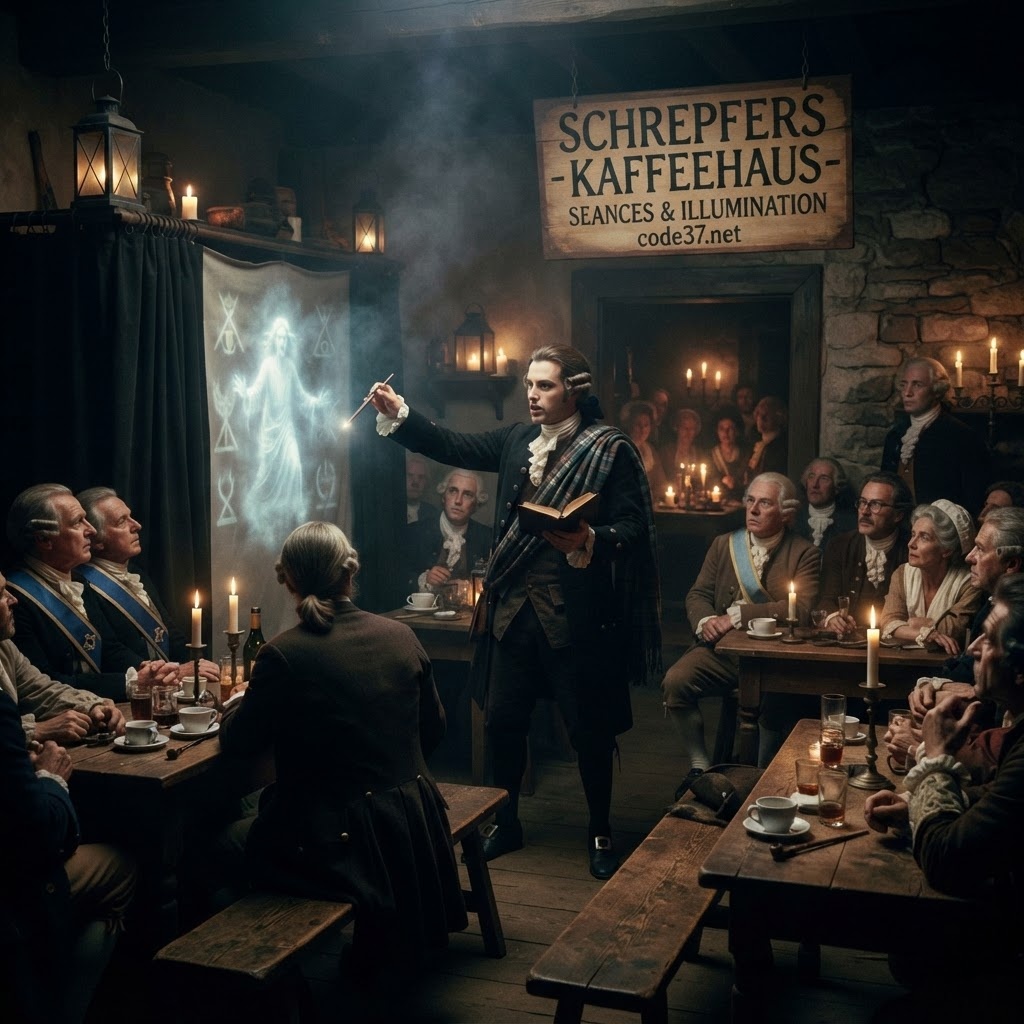
One death that continues to give rise to speculation to this day is that of Johann Georg Schrepfer. This controversial figure was not only active as a Freemason, but also as a spirit summoner, occultist and impostor. Through his séances – during which he was the first to use the ‘Laterna Magica’ projection device to conjure up ghostly apparitions – he even managed to win the trust of the Saxon court nobility and thereby swindle a great deal of money out of them. But let us take things in order. Johann Georg was born in 1738 as the eighth child of an innkeeper from Nuremberg. When his father went bankrupt with his inn ‘Zum Goldenen Lamm’, Johann Georg was only 15 years old. He and two of his brothers subsequently left Nuremberg. He is said to have subsequently served as a Prussian hussar and held the rank of officer in the imperial army. Finally, in 1760, Johann Georg settled in Leipzig, the capital of Saxony, where he initially worked as a waiter. A year later, he married the daughter of a master tailor, before fulfilling his dream in 1769 by purchasing a coffee house in the Barfußgässchen. Johann Georg even obtained a licence for his coffee house – which from then on bore the name ‘Schrepfers Kaffeehaus’ – to serve coffee and tea, as well as to host billiards. However, Johann Georg had run up a large debt in purchasing the building. To pay it off, he began holding séances there for a paying audience. To this end, he not only used the ‘Laterna Magica’, but also had eerie sounds played simultaneously. The séances were regarded as a counter-movement to the Enlightenment and attracted many people, including members of the municipal lodge ‘Minerva of the Freemasons of Strict Observance’, which had been founded in 1766. At the same time, in 1772, he founded a Masonic lodge of his own, which he called the ‘Lodge of True Masonry’ and which drew on the ideas of the Order of the Rosicrucians. The Jesuits presumably supported him in this. Johann Georg posed as a Scotsman whose séances were legendary. However, when two of his followers were refused entry to the Minerva Lodge, he sought them out on 2 March 1773, armed with a pistol. Not only did he insult the Freemasons present, but he also threatened to reveal their rituals and secrets. He reinforced this threat by distributing leaflets. The Minerva Lodge subsequently appealed to their Grand Master, the Duke of Kurland, Karl of Dresden, who had Johann Georg unlawfully arrested by the city commandant on 17 September 1773 in Linck’s Garden, where he was caned at the Hauptwache. Johann Georg did not take this lying down and successfully lodged a complaint with the Leipzig Council. As a result, the matter was settled internally. After Johann Georg had more or less reconciled with the Minerva Lodge, Duke Karl of Courland had his chamberlain, Johann Rudolf von Bischoffwerder, draw up a report on Johann Georg. Surprisingly, this report was so favourable that Johann Georg was invited to the Courland Palace in Dresden, where he conjured up the spirits of the dead for members of the high nobility and the court nobility. Through his spectacular performances, Johann Georg won the trust of the Saxon court nobility and the Minister of State, Friedrich Ludwig von Wurmb. Johann Georg, who was perpetually in financial straits, seized the opportunity by deceiving the Saxon nobility into believing that he held ‘Electoral Saxon Chamber Credit Banknotes’ worth 1 million talers in Swiss banks. In fact, the nobility fell for the ruse and issued tens of thousands of talers in exchange for promissory notes. Even the Minister of Finance, Friedrich Ludwig von Wurmb, who was responsible for Saxon government bonds and their protection, was taken in by Johann Georg. On 15 September, Johann Georg’s treasure chests containing his valuable Cammercreditcassen notes were transported from Frankfurt am Main to Leipzig, where they were opened in the presence of his fellow Freemasons. However, the contents turned out to be completely worthless. The Saxon nobility had fallen for an impostor who had thoroughly swindled them out of their money. The question now was what to do. A public complaint would have led to an unpleasant investigation, which would have set the whole scandal in motion. However, no scandal ensued, as Johann Georg’s body was found on the morning of 8 October 1774 in Leipzig’s Rosental. According to the five defrauded followers, he had allegedly shot himself. The five gentlemen in question were Hans Rudolf von Bischoffwerder and Christian Friedrich von Hopfgarten, chamberlains to the Saxon Duke Karl von Kurland; the Görlitz merchants Fröhlich and Perri; and the Leipzig lawyer Johann Heinrich Hoffmann. They had met at Johann Georg’s house the previous evening and arranged to go for a walk in Rosental with him. By chance, this walk proved fatal for the swindler, Johann Georg Schrepfer, who had double-crossed them. Only a mischievous mind would think ill of it. A report by a Leipzig forensic pathologist from 2011 later concluded that it was ‘suicide’ – albeit one in which physical force had been used to hasten the outcome. The alleged suicide was probably a murder intended to cover up the illicit speculation in Saxon government securities by members of the Saxon aristocracy. Johann Georg Schrepfer’s death caused a great stir at the time, and was immortalised in the works of Friedrich Schiller and other writers.