Isabella Mueller (crime writer)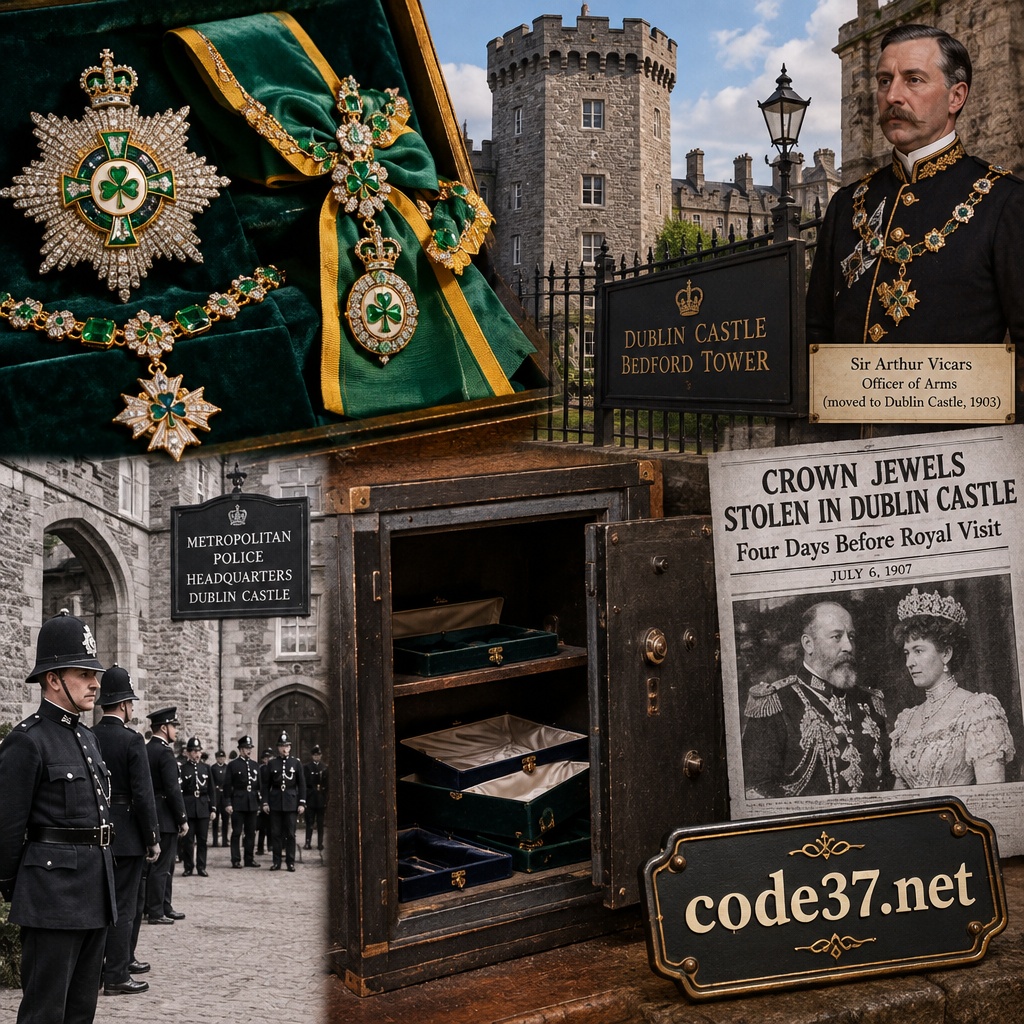
Ireland never had traditional crown jewels, but the jewelled insignia of the Most Illustrious Order of St Patrick were given such a grand title following their disappearance. These magnificent pieces were worn by the King, as Sovereign of the Order, particularly during the official investiture of new Knights of the Order. In 1907, the jewels were stolen from Dublin Castle and have been considered lost ever since. This theft has not yet been solved and is regarded as one of Ireland’s most fascinating unsolved mysteries. In 1783, King George III founded the Order of St Patrick. The Order’s insignia included a breast star and an Order badge worn as a pendant on a shoulder ribbon. In 1831, King William IV had corresponding pieces made, which were lavishly set with rubies, emeralds and Brazilian diamonds. These significant pieces were worn at official events by the King or, if he was unable to attend in person, by the Lord Lieutenant of Ireland in his capacity as Grand Master of the Order. The actual insignia of the Illustrious Order of St Patrick led a rather uneventful existence in Dublin Castle until one of the most mysterious thefts in history took place. It was also noteworthy that these insignia were not typical Crown Jewels and that no crown formed part of the set. King William IV had commissioned a breast star featuring a shamrock and a cross, a medal and a shoulder ribbon, all adorned with Brazilian diamonds and emeralds. These magnificent pieces of jewellery were to be kept securely at all times when not in use. As such, they were usually stored in the vault of Bedford Tower in Dublin Castle. The offices of the Officer of Arms, Sir Arthur Vicars, were relocated here in 1903 to ensure the highest possible level of security. Furthermore, the headquarters of the Metropolitan Police were situated within the castle, which guaranteed comprehensive police protection. On 6 July 1907, just four days before the state visit of King Edward VII and Queen Alexandra to Dublin, it was discovered that the Crown Jewels had disappeared. In the safe, which was located in the office of the Officer of Arms at Dublin Castle, Sir Arthur Vicars, only their cases remained, neatly folded back into place. It appeared as though a thief had helpfully helped themselves and then strolled out undisturbed. The police quickly concluded that someone from the castle’s inner circle must have been involved in the theft, at the very least. Arthur Vicars was the first to notice that the regalia were missing. The police, who had been called in, were unable to find any useful clues, suggesting that the thief had had access to the rooms where the jewels were kept. The seven keys to the office door were in the custody of Vicars and his staff, whilst two further safe keys were in Vicars’ sole possession. However, Vicars was known to get drunk on a regular basis. On one occasion, he even woke up with the jewels around his neck. It is not known whether this was a prank or simply typical behaviour on his part. Enraged, the King insisted on a swift investigation, as his visit to Dublin also carried political significance. Although Ireland was not yet embroiled in the War of Independence, the rift between Unionists and Nationalists had already deepened considerably. At the World’s Fair, there were separate Irish and British pavilions, and political tensions were simmering beneath the surface. The King could ill afford a scandal in such circumstances. Scotland Yard later became involved, but their report apparently alarmed Edward VII so much that it was never published. Even a substantial reward failed to bring the jewels to light. Numerous tips from the public trickled in, but none led to the case being solved. In his desperation, Vicars even followed the advice of a fortune-teller and reportedly had two Dublin cemeteries dug up. The circle of suspects included an illustrious group of people close to Vicars. He had made a number of unfortunate decisions, including the fitting out of the vault, the construction of which was not without flaws. No one had considered that the safe would also have to fit through the door, so it was ultimately placed in the library – a room through which one passes. The list of people with access, however, was short. Vicars was the only one who possessed a key to the safe, and a spare key was kept at his private residence. During the investigation, it emerged that Vicars regularly threw wild parties in the office and had, on at least one occasion, been so drunk that his mates took the key from him, stole the insignia as a prank and sent them back to him by post a few days later. Francis Shackleton, brother of the famous polar explorer Ernest Shackleton, was among the suspects. It was an open secret that Francis was gay and, moreover, often short of money. He frequently stayed at Vicars’ private flat and would therefore have had easy access to the safe keys. Historians suspect that he was also mentioned in the Scotland Yard report and that the King had it made to disappear for fear of a sex scandal. Another suspect was Francis Bennett-Goldney, a man from a family of antique dealers who secured a position with Vicars thanks to a royal letter of recommendation. Decades later, it emerged that Bennett-Goldney possessed a secret hoard of stolen goods, but the Crown Jewels were not found in his possession either. Arthur Vicars maintained until his death that he did not believe any of his friends capable of such a crime. For his notorious negligence, he was ultimately dismissed without honour and shot by the IRA on 14 April 1921. The jewels, however, remain missing. Since the theft of the Crown Jewels in 1907, this mysterious case has inspired numerous writers. Officially, the case was never solved, yet as early as 1908 the famous author Arthur Conan Doyle wrote a variation on the theft in the Sherlock Holmes short story ‘The Bruce-Partington Plans’, which was published in Strand Magazine and later in the collection ‘His Final Bow’ in 1917. Instead of the jewels, submarine plans were the stolen goods, yet the similarities are meticulously crafted. The most recent publication dates from 2010 by Sean Marshall, entitled ‘The Patricius Enigma’. For over a century, the Irish Crown Jewels have vanished without a trace, and the case remains unsolved. The story is notable less for its significance in global politics than for its abrupt ending and a number of absurd twists. The treasures have been as if swallowed up by the earth since 1907, and the numerous theories and suspicions have yet to identify a clear culprit. The theft of the Irish Crown Jewels, which symbolise loyalty to the British monarchy and its influence over Ireland, remains one of the greatest mysteries in Irish history.