Isabella Mueller (crime writer)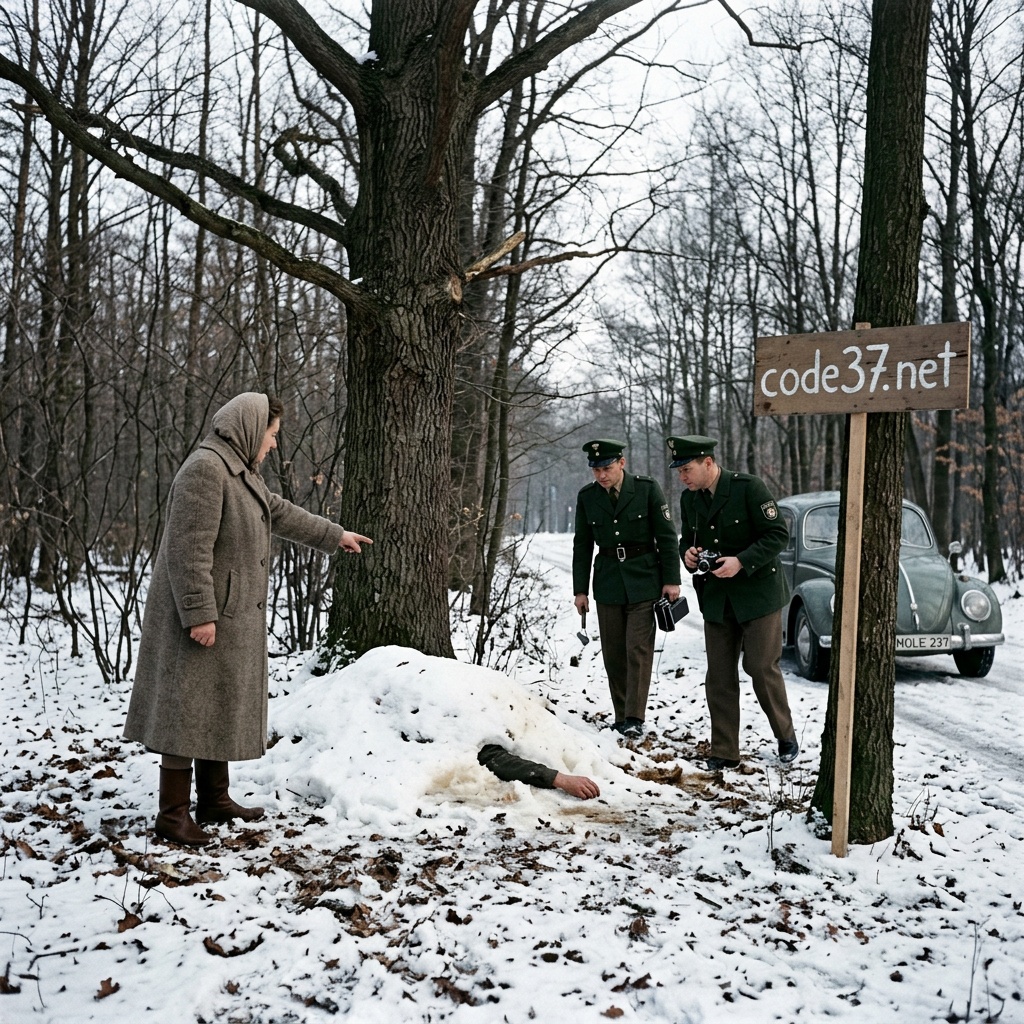
A mysterious criminal case took place in the city of Nuremberg in 1958. It was 9 March 1958 when a woman was out walking in the woods near Nuremberg-Moorenbrunn. The woods were still covered in snow when the woman spotted an arm that had been exposed by the sun beneath the snow. She immediately alerted the police, who then found the body of an elderly lady beneath the remaining snow. She had a gag in her mouth and a cable hanging around her neck. The post-mortem revealed that the woman had been shot. The body turned out to be that of 62-year-old Maria P. from Gera, who had been working as a housekeeper for a wealthy family on Arminiusstraße in Nuremberg. On 20 December, she had suddenly left her employer’s house without warning. Since then, there had been no trace of Maria. The criminal investigation department worked flat out to establish what had happened to Maria P., who had neither any wealth nor any dark secrets. Nevertheless, she had been murdered. But why, and by whom? All leads initially came to nothing, until in August a mushroom picker discovered another body not far from where Maria’s body had been found, between Fischbach and Birnthon. This time, the body was that of 36-year-old Matthias N., who had been reported missing to the police. The post-mortem revealed that Matthias, like Maria, had been shot. Furthermore, a piece of cloth was found in his mouth. He had therefore also been gagged, just like Maria. Could this be a coincidence? The investigators combed through Matthias’s social circle; he and his wife were subtenants of 65-year-old Elisabeth W. on Kirchenweg. The investigators now wanted to question them, but Elisabeth W. had vanished into thin air. No one knew where the lively elderly lady had got to. She had last been seen with two men who had posed as detectives and wanted to search Matthias’s flat. However, Elisabeth found the two men and their ID cards suspicious, which is why she refused to let them into Matthias’s flat. Since then, Elisabeth had been considered missing. It transpired that no detectives had been sent to Elisabeth’s house. They had evidently used forged ID cards to gain entry to Matthias’s flat. But why? A week after Matthias’s body was found, another gruesome discovery was made. The tenant of the pond near Lauf found an arm whilst clearing weeds. The ring on the finger identified it as belonging to Elisabeth W., the subtenant. The investigators were now clearly dealing with three murders, which greatly increased public pressure. To solve the baffling series of murders as quickly as possible, a special task force comprising 22 officers was formed. A frantic search was launched for Elisabeth’s remains, which were found 100 metres from the pond in the undergrowth. Elisabeth, too, had been killed by a shot to the head. During the investigation, Matthias’s savings book, containing 20,000 marks, came to the forefront of the inquiry. A bank clerk reported that, on 22 July, a man had attempted to withdraw the 20,000 marks from the savings book. As the sum was very large, the bank clerk wanted the passbook holder to withdraw the money himself. The man then left the bank empty-handed, but left the passbook behind. Matthias’s wife said that her husband had told her the day before that he intended to meet a colleague the following day, that is, on 22 July. During the investigation, it came to light that Matthias had been advertising loans. This was the lead the officers had been looking for. It was in this way that Matthias had met his killer, who picked him up on the morning of 22 July to drive with him to a estate agent. Matthias had made a point of taking his savings book with him, as the estate agent was supposed to give him advice on how to invest the money profitably. The two men then killed Matthias to get hold of his savings book. Elisabeth also had to die, as she could have identified the two men. But who were these two men? This question was not answered until 12 October, when an employee at the printing works on Jagdstraße rang the police. She had found a customer’s order highly suspicious. A man had introduced himself to her, showing his staff ID, as Otto R., an administrative inspector, who wanted a large number of holiday vouchers printed for the charitable holiday fund for the construction industry. The plan was to exchange the vouchers for cash at the banks. But the man hadn’t reckoned with the resourceful printing works employee, who immediately alerted the police. As a result, the patrol were able to arrest Otto R. on the spot; he was a criminal known to the police. But then the unthinkable happened: Otto R. swallowed a cyanide capsule unnoticed whilst in the police car. He died whilst still on the way to hospital. During the subsequent house search, three pistols and a passport photograph of a man were found in Otto’s wallet. The man turned out to be the previously convicted Richard M., who was apparently the accomplice of Otto R., a former SA member and Foreign Legionnaire. The photograph was to be used to produce another forged service ID card. Richard M. was convicted of triple murder but died in prison whilst serving his sentence. But why did Maria have to die? The investigation revealed that she was presumably a witness to a planned attack by the two men on their boss. Yet, for inexplicable reasons, the murderous duo abandoned their plan. This solved the mystery surrounding the triple murder.