Isabella Mueller (crime writer)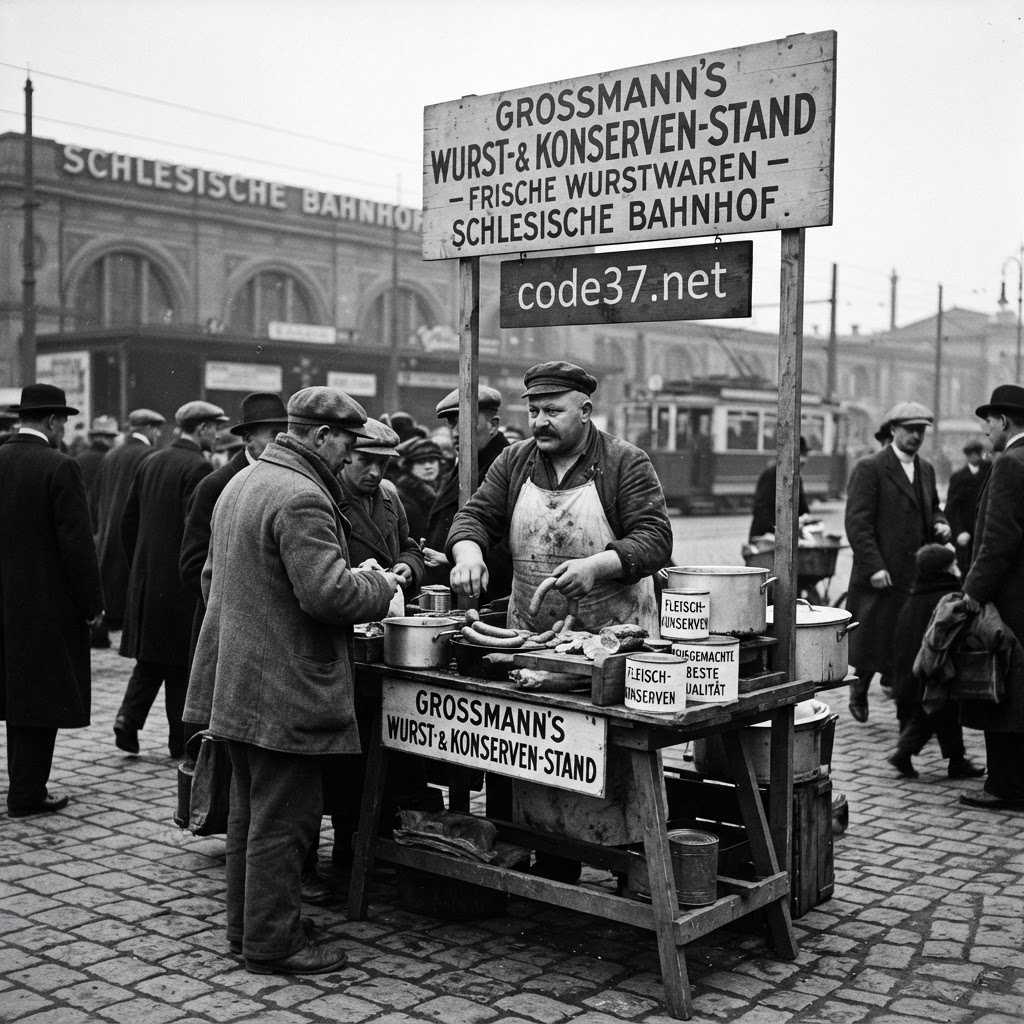
A serial killer who, according to rumors, sold canned sausages containing human flesh at the Schlesischer Bahnhof in Berlin was the peddler Carl Großmann. This ruthless serial killer, who allegedly slaughtered 23 women in cold blood on his wooden bench, was born on December 13, 1863, in Neuruppin. Großmann’s childhood was marked by his alcoholic and violent father, the rag-and-bone man Carl Friedrich Großmann. Großmann left school after third grade and began an apprenticeship at Ferdinand Kliefoth’s butcher shop in 1876. He was fired from there in 1879 for making sexual advances toward the butcher Kliefoth’s wife. Großmann moved to Berlin, where he worked at the Naujocks butcher shop from 1880 to 1895, until he decided to roam southern Germany as a peddler, beggar, and petty criminal. Großmann committed various crimes. After brutally raping a 4-year-old girl, he was sent to prison. Upon his release, however, he showed no signs of reform; not only did he commit sodomy with a goat, but he also sexually abused another 4-year-old and a 10-year-old girl. For this, he was sentenced on October 4, 1899, in Bayreuth to 15 years in prison for sexual offenses, where he was feared by his fellow inmates because he regularly beat them up. After serving his sentence, Großmann lived at Lange Straße 88, in a third-floor apartment near the Schlesischer Bahnhof, starting in 1913. This neighborhood in Berlin was plagued by constant murder and manslaughter, which is why it was also known as the “Chicago of Berlin.” Starting in 1918, body parts of women began turning up repeatedly in the Engelbecken pond, which was scarcely used by boats anymore. A serial killer was on the loose there. At that time, 57-year-old Carl Friedrich Großmann was a regular at the 50th Police Precinct on Kleine Andreastraße, which was not far from his apartment. He filed reports there regularly, claiming that he had been repeatedly robbed by his housekeeper, who then suddenly vanished without a trace. In total, Großmann filed 40 to 50 reports, none of which any of the police officers at the station took seriously. Großmann, who had previously worked as a butcher, ran a sausage stand at the Schlesischer Bahnhof, where he sold his canned meat products, which presumably contained macabre ingredients. One day after Großmann had once again filed a report regarding his thieving housekeeper, his neighbor Robert Iglitzki arrived at the 50th Police Precinct on August 21, 1921, at around 9:30 p.m., completely distraught. He had heard a woman’s cries for help coming from Großmann’s apartment. The police immediately drove there and pounded on Großmann’s door. But he refused to open the door, so the officers kicked it down. Großmann staggered toward them, a cup in his hand. It later turned out that the cup had contained a half-dissolved cyanide capsule. Großmann had intended to take his own life with it. On Großmann’s bed, the police discovered a naked, bound woman bleeding from her lower abdomen; she was already dead. Großmann claimed that he had paid her for bondage sex. Indeed, there were 300 marks in one of the woman’s socks, though it was smeared with blood. It was therefore clear that Großmann had placed the money there. During the search of the house, the police found two severed women’s hands, women’s clothing, and bloodstained bags in the kitchen stove. Großmann had evidently used the bloodstained wooden bench as a chopping block. He had dismembered the women there and disposed of body parts in the Engelbecken and the Luisenstädtischer Canal, where they resurfaced from time to time. Additionally, on the property of a cottage near Alt-Landsberg that had once belonged to Großmann, further items were found that could be linked to the discovered bodies. Großmann was placed in pretrial detention. The interrogation was conducted personally by Criminal Inspector Ernst Gennat, the head of the homicide division. Großmann confessed to only three murders of women. Großmann’s “hunting ground” was the Schlesischer Bahnhof, where he approached women who came from the most remote rural areas. He offered them a job as a housekeeper and lured them into his apartment with the promise of a glass of milk and a slice of bread with lard, where he sexually assaulted them and then killed them. He is said to have subsequently processed their bodies into his canned meat. Großmann was assigned the star defense attorney Dr. Dr. Erich Frey. However, the numerous women who had survived Großmann were sufficient to secure a conviction. Furthermore, he had confessed to three murders. This ensured he would receive the death penalty. Although the police had evidence that Großmann was responsible for the deaths of at least 23 women, these cases were not pursued further due to the impending death sentence. However, Großmann escaped the death penalty because he hanged himself in his cell on July 5, 1922, before he was sentenced. Thus, one of the most horrific serial killers of the Weimar Republic died.