Isabella Mueller (crime writer)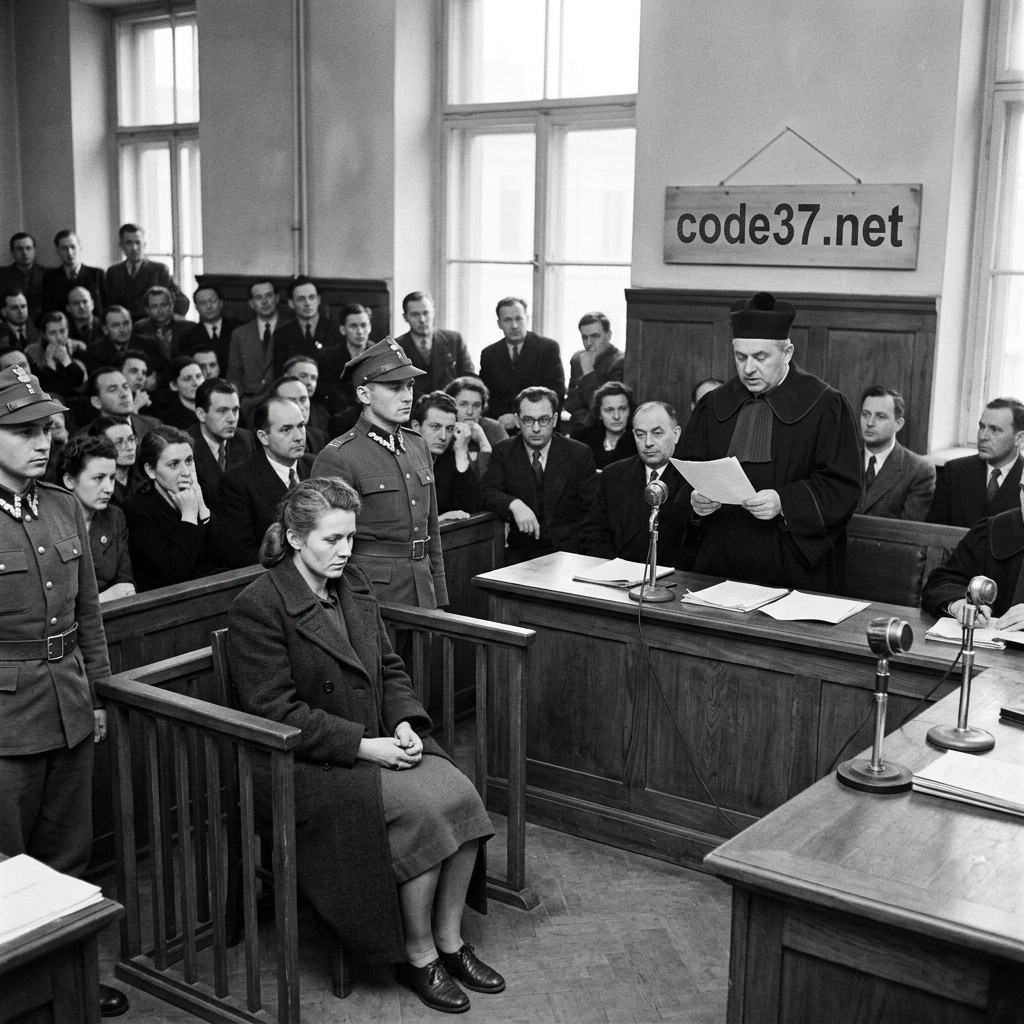
Maria Mandl was a mass murderer responsible for the deaths of over 1,000 people. She was born on 10 January 1912 as the fourth child of a master shoemaker in the Upper Austrian town of Münzkirchen. After attending primary school, Maria initially worked as a housekeeper in the local area before moving to Switzerland and later to Innsbruck. In 1937, she returned to Münzkirchen, where she subsequently worked at the post office. Just one year later, she joined the SS and moved to Munich in September of that same year. After a month, on 15 October 1938, Maria took up a post as a guard at the Lichtenburg women’s concentration camp, one of the first concentration camps in Germany. Maria enjoyed her job because it allowed her to exercise power over other people. If the female prisoners did not obey, Maria had them beaten and would take the whip herself, which earned her the nickname ‘the Beast’ amongst the prisoners. Maria remained at the Lichtenburg concentration camp until 15 May 1939. Following its closure, Maria and the other female guards and prisoners were transferred to the Ravensbrück concentration camp. There, Maria initially worked as a ‘Kommando’ leader, before being promoted to prison guard at the beginning of 1940. On 4 April, her membership of the NSDAP was confirmed. Due to her strictness and her heavy-handed approach towards the prisoners, Maria rose to the rank of chief guard, the highest position a female guard could hold. She retained this position when, from 7 October 1942, she was transferred to Auschwitz-Birkenau concentration camp, the largest German extermination camp in the Nazi state. Maria, who had been camp commander since 1942, ran the women’s camp from August 1943 to January 1944 alongside camp commander Franz Hößler. In her role, Maria decided matters of life and death; anyone who was too weak, too ill or too old to carry out forced labour ended up in the gas chamber. Maria also selected the women and children for human experiments. Maria’s love of music was even greater than her penchant for sadism. Thus, Maria founded the legendary Auschwitz Women’s Orchestra, which was forced to march up and play every day at the roll call for the labour columns. Those who were members of the orchestra had hit the jackpot, as these women were given clean cells, sufficient food and good clothing. Meanwhile, in the other cells, appalling hygienic conditions prevailed and food was so rationed that it was barely enough to survive on. As Maria performed her duties excellently, she was even awarded the War Merit Cross, 2nd Class. In November 1944, Maria was transferred to the Mühldorf concentration camp, a satellite camp of the Dachau concentration camp, where she also worked as a senior guard. Everything changed after the end of the Second World War. Maria tried to find refuge with her parents in her hometown of Münzkirchen. However, they refused to take her in, whereupon she fled to her sister’s home not far from Luck. There, on 10 August 1945, Maria was arrested by US soldiers and, following her interrogation, extradited to the People’s Republic of Poland. On 22 December 1947, Maria was sentenced to death by hanging by the Supreme People’s Tribunal at the Kraków Auschwitz Trial for her war crimes. Whilst still in custody, she wrote letters in which she justified her actions by claiming that she had merely been carrying out her duties as a senior guard. She had simply ensured law and order in the women’s camp. On 24 January 1948, Maria was hanged at Montelupich Prison along with 20 other war criminals from the Auschwitz concentration camp. Her alleged last words were: ‘Long live Poland.’ Her body was subsequently taken to the Institute of Anatomy at the University of Kraków, where it served as teaching material for medical students. Years after Maria’s death, there was significant media interest because, in 1975, the Ried im Innkreis District Court had issued a certificate of death for Maria at the insistence of her home town of Münzkirchen. In this document, the war criminal Maria was portrayed as a concentration camp victim who had been sent to the camp in 1939 and had presumably died there in 1944. However, this falsification of history was exposed, and in April 2017 the Ried Regional Court issued a corrected ruling. Yet this did not mark the end of the story of the war criminal Maria Mandl, as she continues to provide ample material for films and books to this day.